Dacia Spring
Range is accredited in according to a standard regulatory method. Identical for all manufacturers, this enables vehicles to be compared with one another.
Range in real time depends on vehicle usage conditions, equipment fitted and the user’s driving style. To optimise range, please refer to the following advice.
Depending on the versions, you will be provided with functions which enable you to lower energy consumption:
- on the instrument panel:
- the econometer;
- the driving style indicator;
- the acceleration indicator Eco.
- on the multimedia screen:
- data relating to your energy consumption;
- an energy consumption graph;
- scores based on your driving style;
- Eco driving advice;
- an ECO driving mode.
On the instrument panel A
Depending on the vehicle, the information display can be organised and customised based on the instrument panel customisation style selected from the multimedia screen.
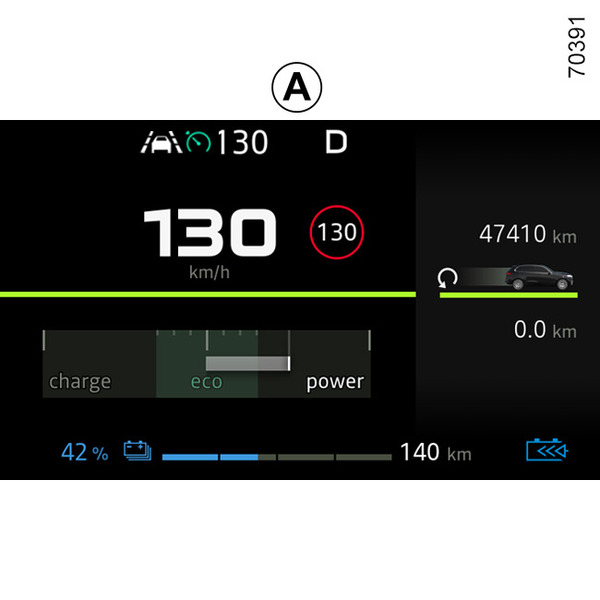
Econometer
(on the instrument panel)
The econometer gives the driver a real-time view of the vehicle’s energy recovery or consumption.
« Energy recovery » A usage zone
When driving, if you lift your foot off the accelerator pedal or press the brake pedal, the motor generates electrical current during deceleration, and this energy is used to slow down the vehicle and recharge the traction battery
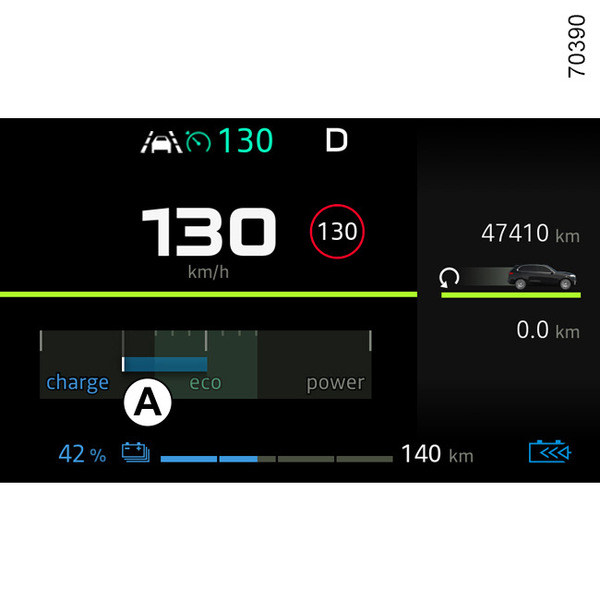
« Optimal » 0 usage zone
(depending on vehicle)
Indicates nil consumption.
« Consumption recommended » usage zone B
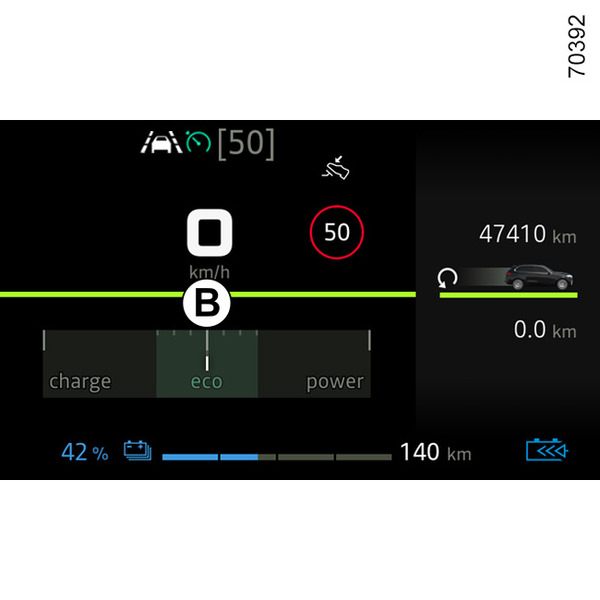
The traction battery supplies the electrical energy required for the motor to move the vehicle.
« Consumption not recommended » usage zone C
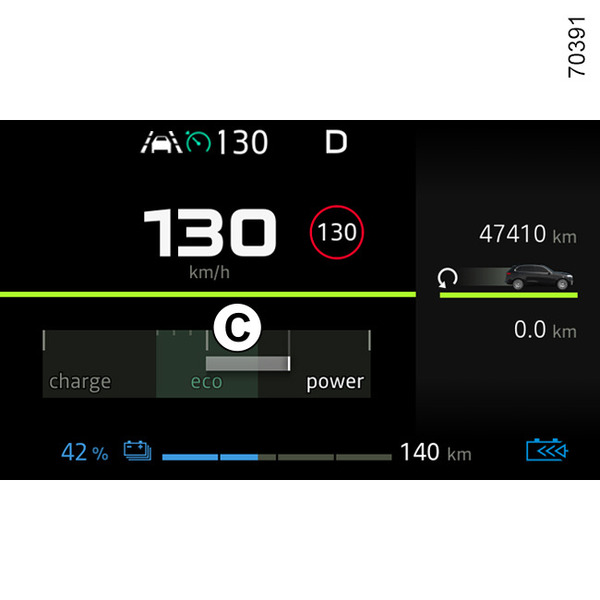
Indicates high energy consumption.
tip
The presence and display of this information depends on the ambient setting selected.
Driving style indicator 1
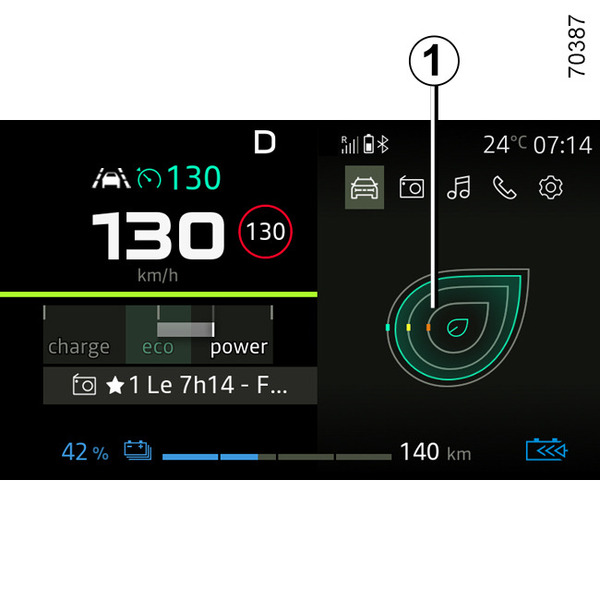
After activation, you will be informed about the driving style adopted in real time. You will be notified by indicator 1.
The more petals displayed on the indicator 1, the more your driving is flexible and economical.
If you regularly monitor this indicator, you will reduce your vehicle’s *energy consumption.
Please refer to the multimedia instructions for further information.
Acceleration indicator Eco 2
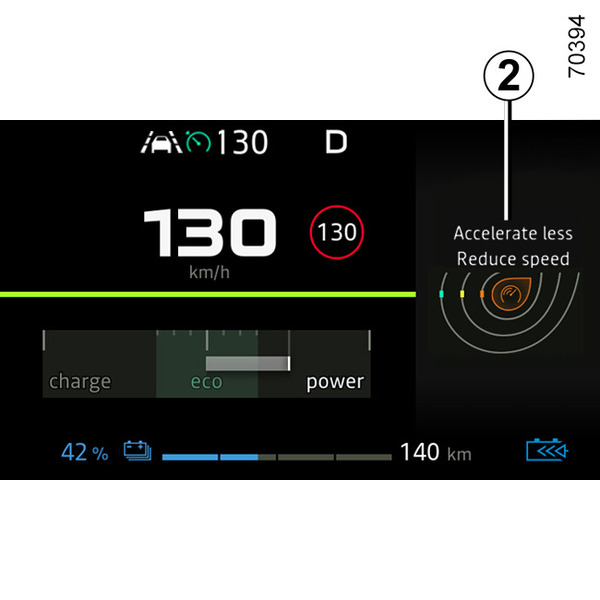
Depending on the vehicle, this informs you in real time whether you are accelerating moderately or strongly.
You will be notified by indicator 2:
green: acceleration is moderate and correct;
white: acceleration is too high;
grey: acceleration is high.
Note: it is not possible to simultaneously display the driving style indicator 1 and the Eco acceleration indicator 2.
On the multimedia screen 3
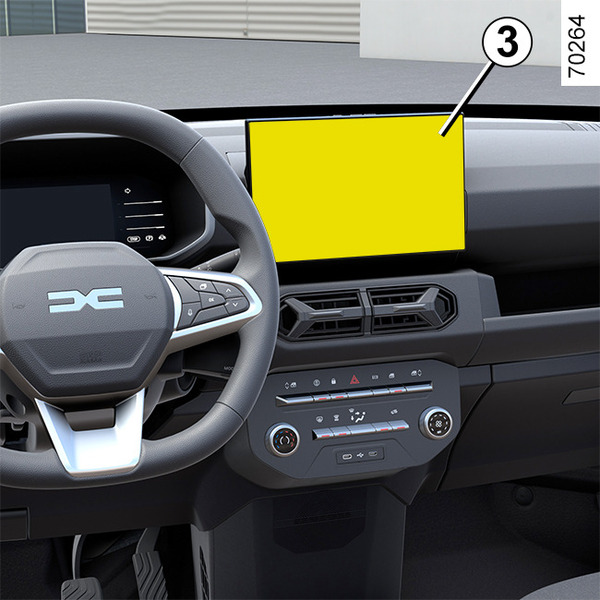
Journey record
On equipped vehicles, once the engine is switched off, a « Journey record » is displayed on the multimedia screen 3. This log shows the information relating to your last journey:
- your average energy consumption;
- the number of miles/kilometres travelled;
- an overall grade taking into account acceleration, braking anticipation and your skill in managing speed;
- advice to enable you to improve your rating.
An overall rating from 0 to 100 is displayed to let you assess your eco driving performance.
The higher the rating, the lower the energy consumption.
Eco advice is given to help improve your performance.
Please refer to the multimedia instructions for further information.
Eco mode function
The ECO function optimises vehicle range by limiting engine performance and maximum speed (limited to approximately 62 mph (100 km/h). It acts upon some consumer systems in the vehicle (power-assisted steering etc.) and on certain driving actions (acceleration, deceleration etc.).
Activating the function
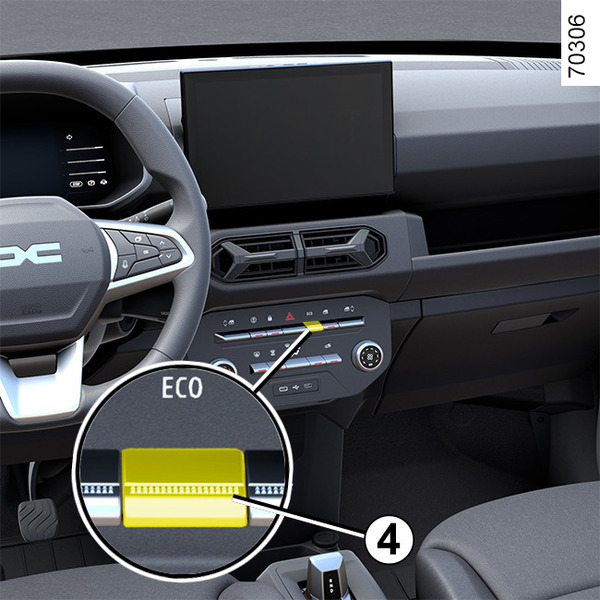
Press switch 4
Warning light 5 will come on the instrument panel and the integrated warning light on the switch will light up.
While driving, it is possible to exit the ECO mode temporarily in order to improve engine performance.
To do this, press the accelerator pedal firmly and fully.
ECO mode is reactivated when you take pressure off the accelerator pedal.
De-activating the function
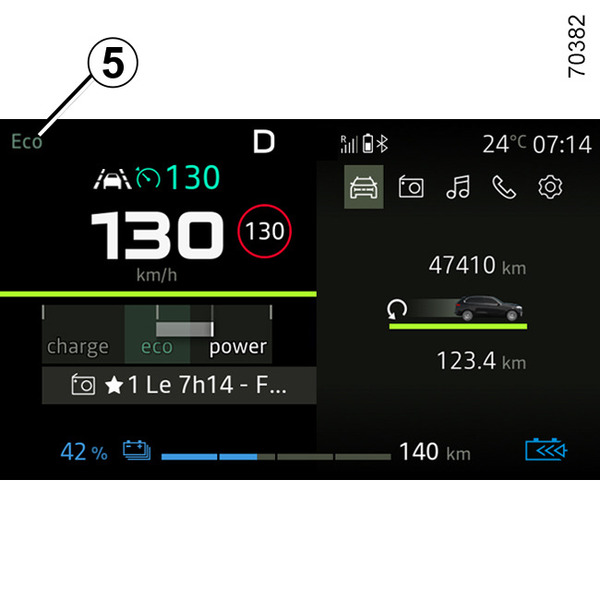
Press switch 4.
Warning light 5 goes out on the instrument panel.
Vehicle range
Advice
In real usage, the range of an electric vehicle may vary depending on several factors over which you have partial control, which may make a considerable difference to the vehicle range.
These factors are:
- speed and driving style;
- road type;
- heating level;
- tyres;
- use of electrical accessories;
- vehicle loading.
Furthermore, activating mode ECO enables the vehicle to automatically take charge of all energy consumers (engine power etc.) to reduce their consumption to the fullest possible extent Eco mode function.
Speed and driving style

Driving at high speed will significantly reduce your vehicle's range.
Examples (at a steady speed):
- reducing the speed from approximately 80 mph (130 km/h) to 68 mph (110 km/h) allows you to save up to around 20% of fuel range;
- reducing your speed from approximately 56 mph (90 km/h) to 50 mph (80 km/h) allows you to save up to around 10% of fuel range.
« Sporty » driving reduces your vehicle's range: opt for a « smoother » driving style.
Advice :
- drive at a constant speed ;
- keep an eye on the tools available to you to view the road conditions (charge meter, current consumption, journey record, etc.) Eco mode function;
- adapt your driving style to avoid excessive energy consumption;
- favour energy recovery: anticipate traffic changes by taking your foot off the accelerator pedal or braking gradually.
Road type
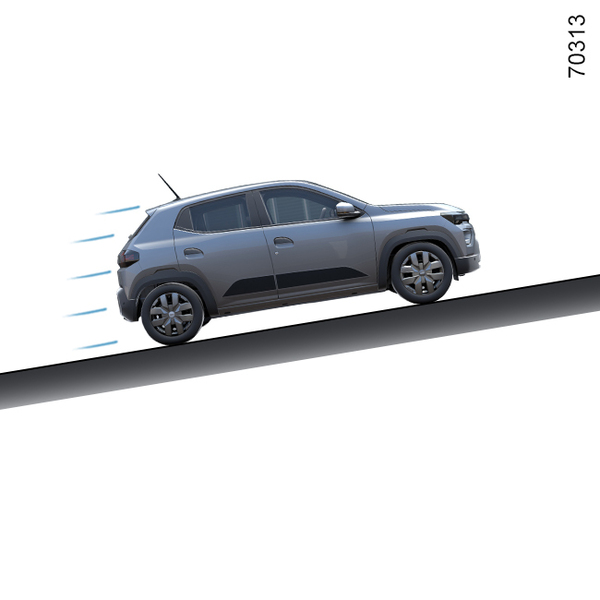
Do not try to maintain the same speed up a hill; accelerate no more than you would on the level. Keep your foot in the same position on the accelerator pedal.
Heating levels
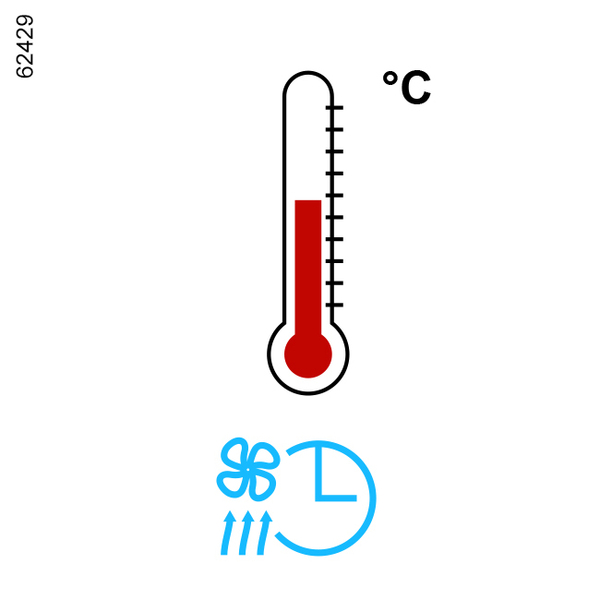
The use of heating or air conditioning reduces vehicle range.
To maintain your vehicle range, we recommend that you select the « Programmable Heating & Air-Conditioning » mode before using the vehicle Air conditioning: programming.
Tyres
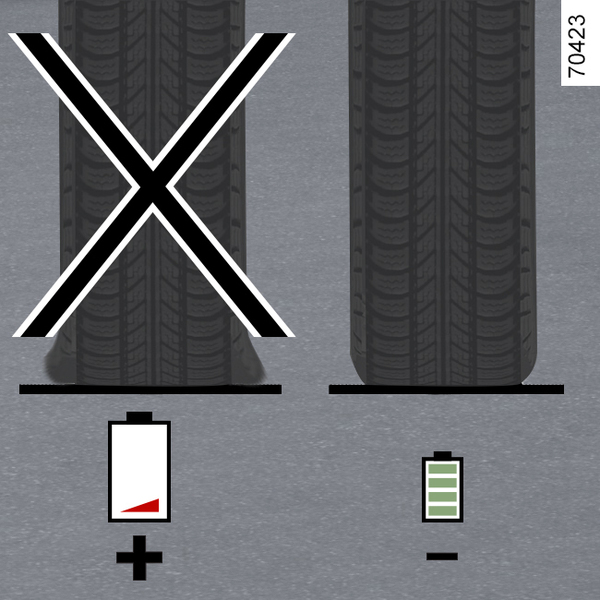
An under-inflated tyre increases energy consumption. Comply with the specified tyre pressures for your vehicle.
When driving, use tyres made by the same manufacturer, with the same dimensions, type and structure as the original tyres. The use of non-regulation tyres significantly reduces vehicle range Tyre pressure.
Vehicle loading
Avoid pointlessly overloading your vehicle.