Dacia Jogger
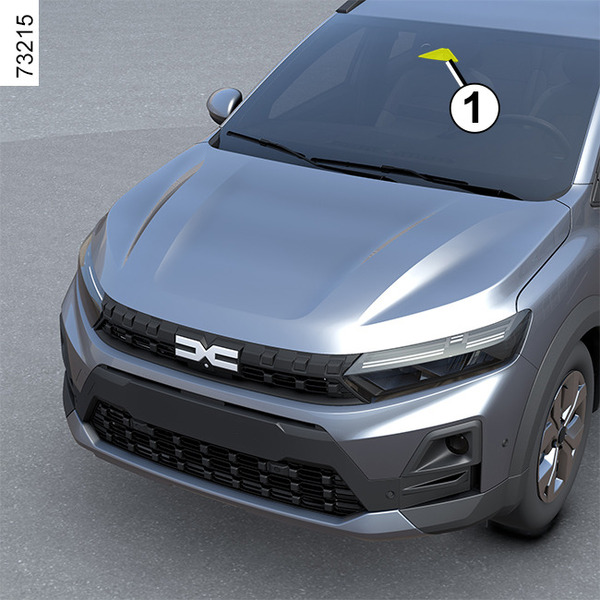
Using the information from the camera 1, this function informs the driver of the time interval between their vehicle and the vehicle in front so that a safe stopping distance between the two vehicles can be maintained.
The function is activated when the vehicle speed is between approximately 19 and 124 mph (30 and 200 km/h), depending on the vehicle.
Location of camera 1
Make sure the windscreen is not obscured (by dirt, mud, snow, condensation etc.).
warning
This function is an additional driving aid. This function is not under any circumstances intended to replace the due care and attention of the driver, who should at all times be in control of the vehicle.
Activating/deactivating the function
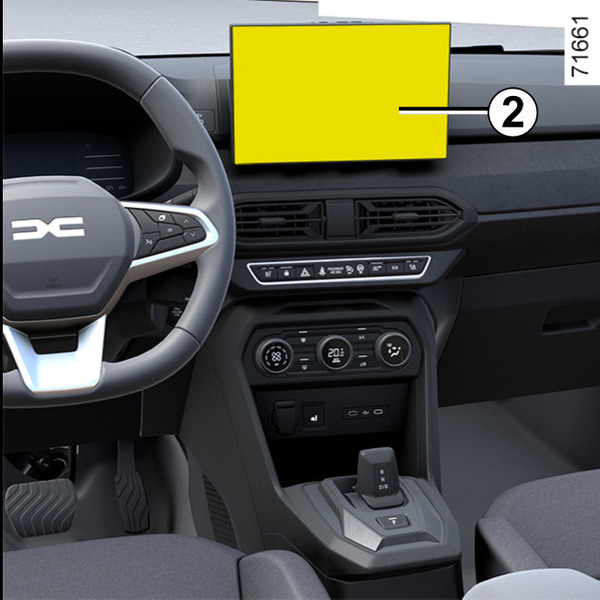
Vehicles fitted with a multimedia screen 2
From the "Vehicle" world on your multimedia screen 2, press the "Driving assistance" menu.
Activate or deactivate the "Following distance" function.
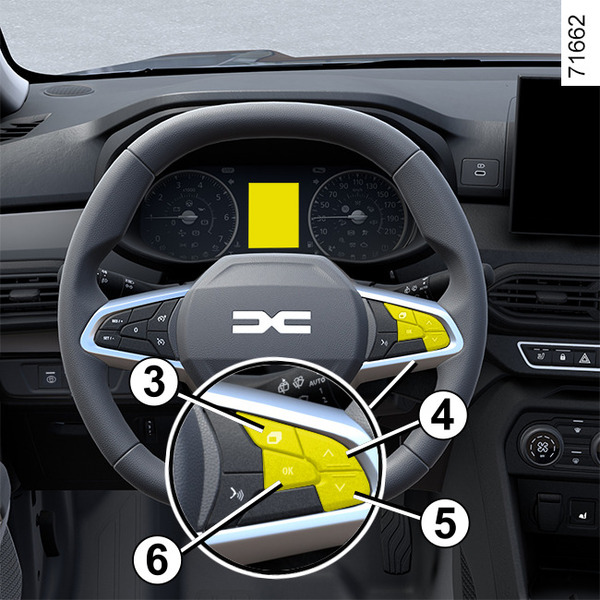
Vehicles not fitted with a multimedia screen
(depending on the vehicle)
- With the vehicle stationary, press the switch 3 as many times as required to reach the
 tab;
tab;
or
- press control 3 and repeatedly press control 4 or 5 to reach the
 tab;
tab; - press switch 6 "OK";
- repeatedly press control 4 or 5 to reach the
 menu, then press the 6 "OK" switch;
 - repeatedly press control 4 or 5 to reach the "DRIVING ASSIST" menu, then press switch 6 "OK";
repeatedly press control 5 or 6 to reach the "Distance warning" menu, then press switch 6 "OK";
press switch 6 "OK" again to activate or deactivate the function:
-
 function activated;
 -
 function deactivated.
-
tip
Each time the vehicle is started, the function continues the mode saved the last time the engine was stopped.
Operation
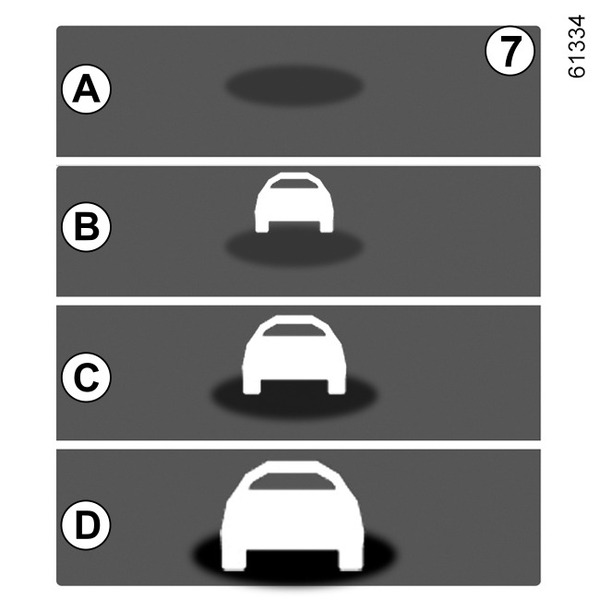
With the function activated, the 7 indicator is displayed on the instrument panel and informs the driver of the distance between their vehicle and the vehicle in front.
- A (grey): function not operational;
- A (green): no vehicle detected;
- B (green): the time interval is greater than or equal to around two seconds (distance between the two vehicles adapted to your speed);
- C (yellow): the time interval is between approximately one and two seconds (insufficient distance between the two vehicles);
- D (red): the time interval is less than or equal to around one second (very insufficient distance between the two vehicles).
If the interval between the two vehicles is less than around 0.5 seconds, notification 7, display D, will remain lit red on the instrument panel.
Under certain conditions, the time interval may not be displayed:
- while cornering;
- when changing lane;
- if the vehicle in front is sufficiently far or outside the range of the camera.
Warnings
warning
The measurement is displayed for information: the system does not carry out any action on the vehicle.
This function is not designed for use in urban conditions or for a dynamic driving style (sudden cornering, acceleration, braking, etc.), but rather for stable driving conditions.
The function does not interact with the braking system.
the camera should be kept clean and free of any modifications in order to ensure the proper operation of the system.
Any work in the area where the camera is located (repairs, replacements, windscreen modifications etc.) must be carried out by a qualified professional.
warning
This function is an additional driving aid. This function is not under any circumstances intended to replace the due care and attention of the driver, who should at all times be in control of the vehicle.
System servicing/repairs
- In the event of an impact, the camera alignment may be changed and its operation may consequently be affected. Deactivate the function and consult an approved Dealer.
- Any work in the area where the camera is located (repairs, replacements, windscreen modifications etc.) must be carried out by a qualified professional.
Only an approved Dealer is qualified to service the system.
In the event of system disturbance
- windscreen obscured (by dirt, ice, snow, condensation etc.);
- a complex environment (metal bridge, tunnel, etc.);
- poor weather conditions (snow, hail, black ice, etc.);
- poor visibility (night, fog, etc.);
- poor contrast between the vehicle preceding it and the surrounding area (e.g. white vehicle in a snowy area, etc.);
- being dazzled (glaring sun, lights of vehicles travelling in the opposite direction; etc.);
- the road is narrow, winding and undulating (tight bends etc.)
Risk of erroneous false alarms.