Dacia Jogger
Fuel consumption is accredited in accordance with a standard regulatory method. Identical for all manufacturers, this enables vehicles to be compared with one another. Consumption in real time depends on vehicle usage conditions, the equipment fitted and the user's driving style. To optimise fuel consumption, please refer to the following advice.
Depending on the vehicle, you have different functions to help you reduce your fuel consumption.
On the instrument panel:
- the rev counter;
- the gear change indicator;
- the driving style indicator;
- ECO mode;
- the Stop and StartStop and Start function function;
- the power meter;
- the navigation system.
On the multimedia screen (for more information, see the multimedia system user manual):
- data relating to your energy consumption;
- an energy consumption graph;
- scores based on your driving style;
- ECO driving advice;
- the journey record and eco-driving advice via the multimedia screen;
- an ECO driving mode.
On the instrument panel A or B
Depending on the vehicle, the information display can be organised and customised based on the instrument panel customisation style selected from the multimedia screen.
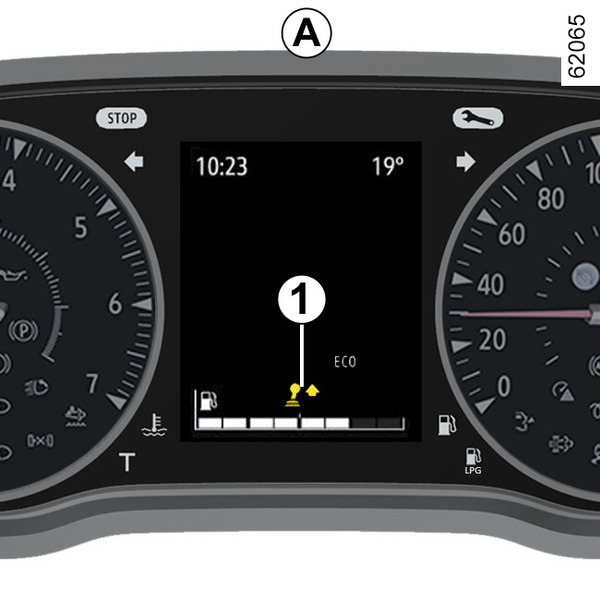
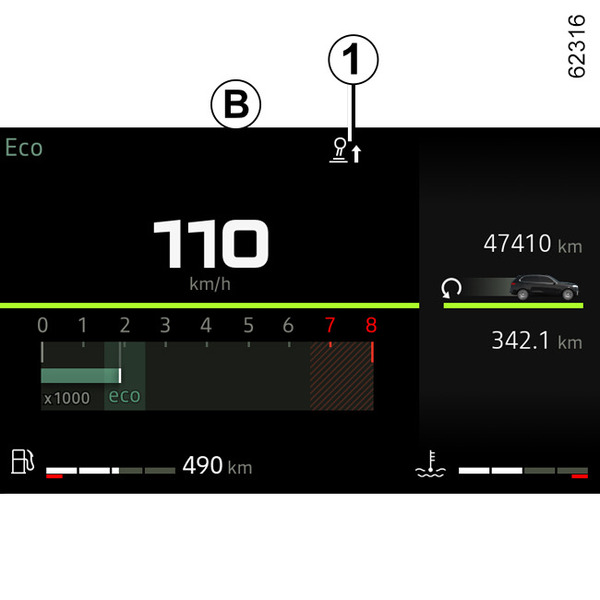
Gear change indicator 1
Depending on the vehicle, to obtain optimum consumption levels, a warning light on the instrument panel lets you know the best time to move up or down a gear:
 shift up a gear;
 downshift a gear.
If you regularly follow this indicator, you will reduce your vehicle’s fuel consumption.
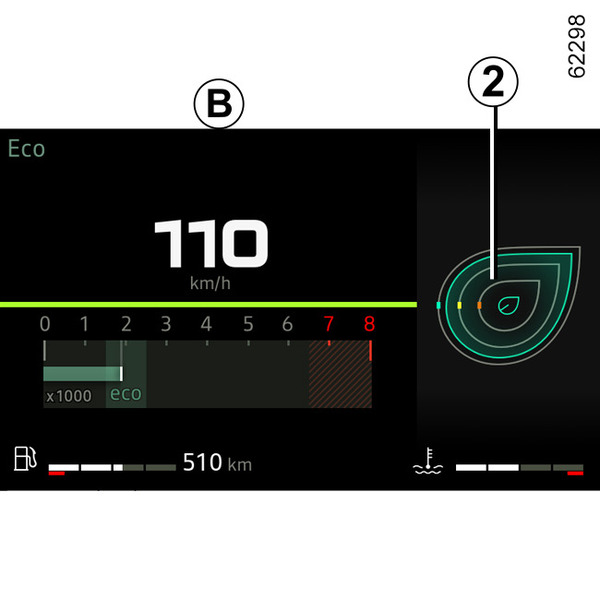
Driving style indicator 2
After activation, you will be informed about the driving style adopted in real time. You will be notified by indicator 2.
The more petals displayed on the indicator 2, the more your driving is flexible and economical.
If you regularly monitor this indicator, you will reduce your vehicle’s fuel consumption.
Please refer to the multimedia instructions for further information.
On the multimedia screen
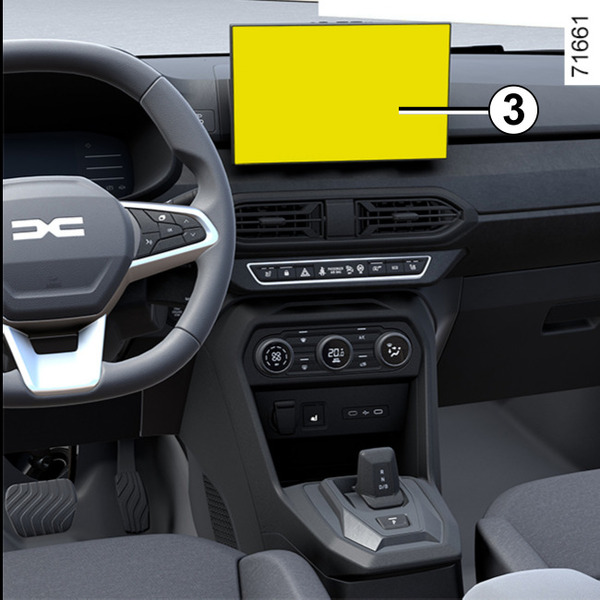
Journey record
Once the engine is switched off, you will see "Journey record" displayed on the multimedia screen 3, enabling you to view information on your last journey.
This indicates:
- general score;
- score evolution;
- distance without fuel consumption.
An overall rating from 0 to 100 is displayed to let you assess your eco driving performance.
The higher the rating, the lower the fuel consumption.
Eco advice is given to help improve your performance.
With your favourite journeys saved, you can compare your performance between trips and the performance of other vehicle users.
Please refer to the multimedia instructions for further information.
ECO mode
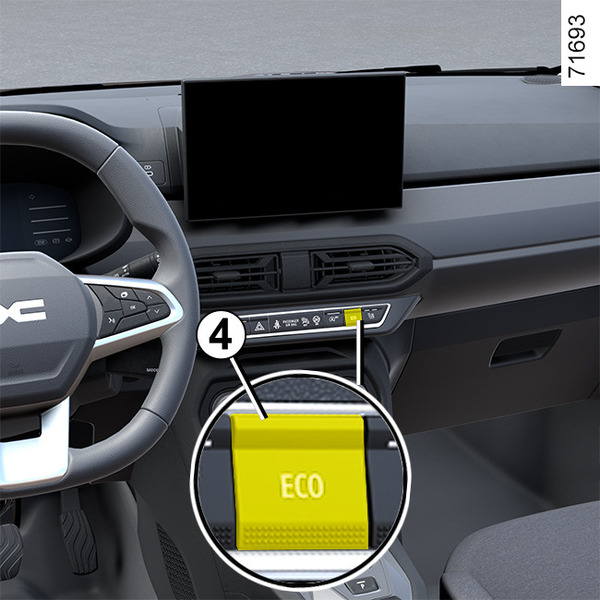
(depending on the vehicle)
ECO mode is a function which optimises fuel consumption. It affects the vehicle behaviour (acceleration, gear shifting, cruise control, deceleration, etc.).
Limiting acceleration enables low fuel consumption in urban and surrounding areas.
Activating the function
Press the switch 4.
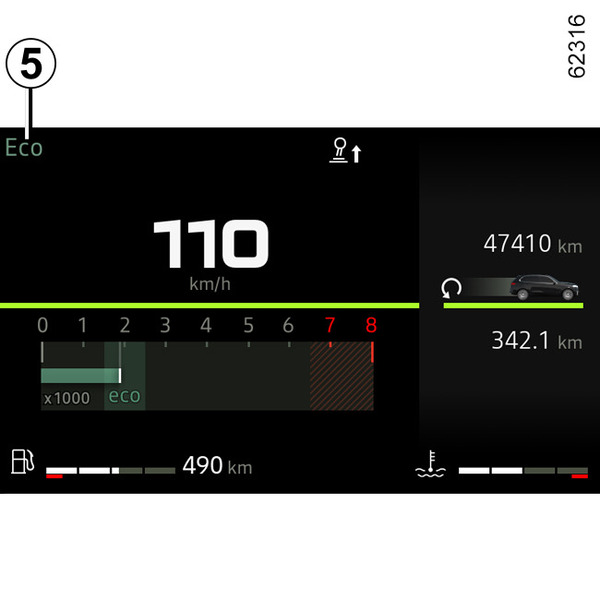
The 5
 warning light comes on on the instrument panel to confirm activation.
While driving, it is possible to exit the ECO mode temporarily in order to improve engine performance.
To do this, press the accelerator pedal firmly and fully.
ECO mode is reactivated when you take pressure off the accelerator pedal.
Deactivating the function
Press the switch 4.
Warning light 5
goes out on the instrument panel to confirm deactivation.
Power meter
(Hybrid version)
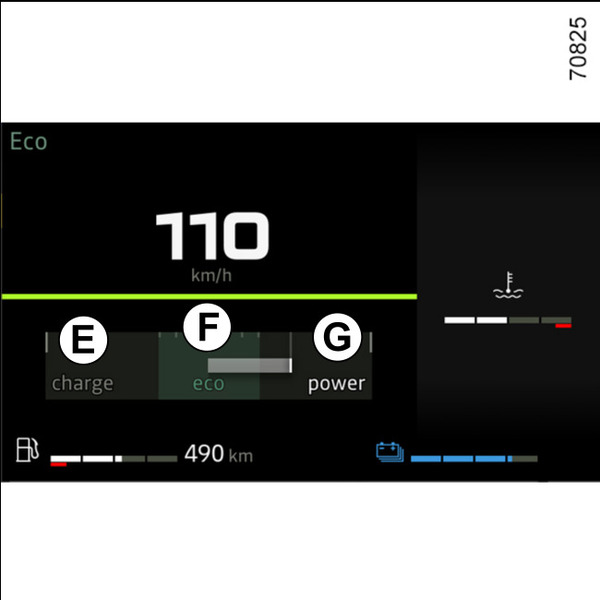
The charge meter gives you a real-time view of the energy consumed or recovered when the vehicle is moving.
"Energy recovery" E usage zone
When driving, if you lift your foot off the accelerator pedal or press the brake pedal, the motor generates electrical current during deceleration, and this energy is used to slow down the vehicle and recharge the traction battery Gear control.
"Optimal" F usage zone
Indicates economical driving, balanced between recovery and energy expenditure.
"Energy consumption" G usage zone
In all-electric or E-tech full hybrid mode, the traction battery and/or the combustion engine supply the energy required to move the vehicle.
Navigation system
Use the information available on your navigation system (traffic information etc.) to simplify your journey.
tip
The presence and display of this information depends on the type of ambient setting selected.
Maintaining the traction battery charge level: « E-Save »
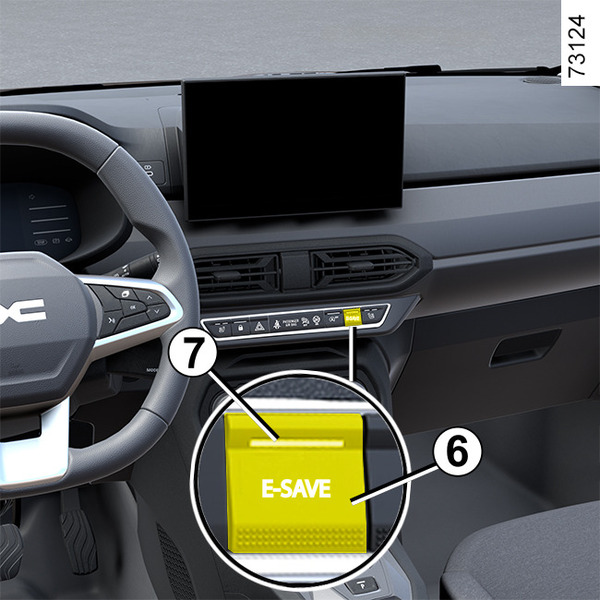
To activate the function, press the 6 switch.
The warning light on top of the switch 7 comes on to confirm activation.
This mode enables you to maintain a sufficient charge level in the traction battery in anticipation of a mountain road or a long motorway slope.
To deactivate the function, press the switch 6.
The 7 indicator light goes out to confirm deactivation.
Driving advice and Eco driving
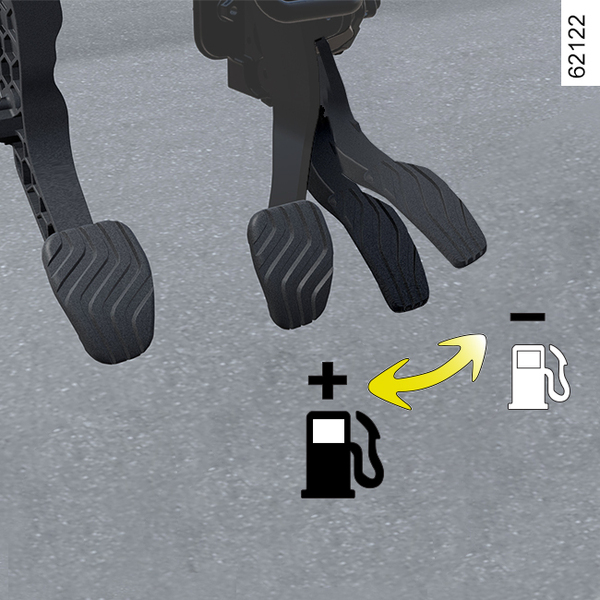
Behaviour
- Drive carefully until the engine reaches its normal operating temperature, rather than let it warm up while the vehicle is stationary.
- High speeds significantly affect the vehicle's fuel consumption.
Examples (at a steady speed):
- reducing the speed from approximately 80 mph (130 km/h) to 68 mph (110 km/h) saves up to around 20% of fuel;
- reducing the speed from approximately 56 mph (90 km/h) to 50 mph (80 km/h) saves up to around 10% of fuel.
- Dynamic driving with a lot of frequent acceleration and braking is expensive on fuel in comparison to the time saved.
- Do not overrev the engine in the intermediate gears. Always use the highest gear possible without labouring the engine.
- Avoid sudden acceleration.
- Brake as little as possible. If you anticipate an obstacle or bend in advance, you may then simply release the accelerator pedal.
- Do not try to maintain the same speed up a hill, accelerate no more than you would on level ground. Keep your foot in the same position on the accelerator pedal.
- Double declutching and accelerating before switching off the engine are unnecessary in modern vehicles.
- Bad weather, flooded roads:
-
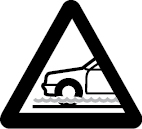
- Do not drive through water if it is higher than the lower edge of the wheel rim.
Heating levels
It is normal to notice an increase in the vehicle's fuel consumption when using the heating (particularly when the outside temperature drops below zero) or air conditioning.
warning
Driver obstruction
On the driver's side, only use mats suitable for the vehicle, attached with the pre-fitted components, and check the fitting regularly. Do not lay one mat on top of another.
There is a risk of wedging the pedals.
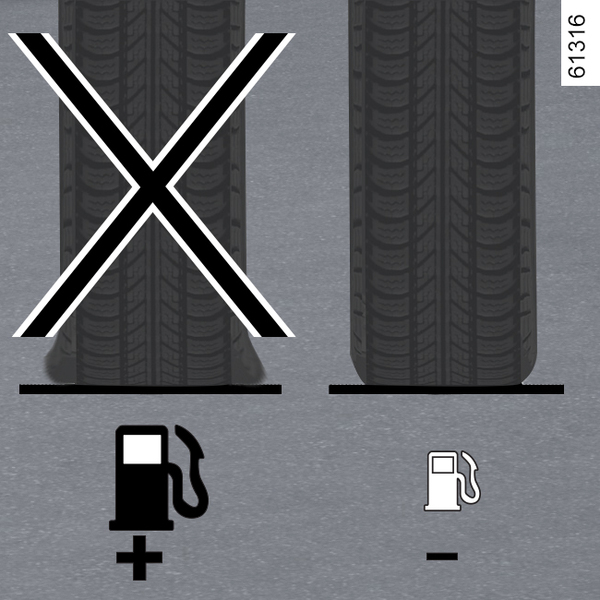
Tyres
- An underinflated tyre increases fuel consumption.
- To optimise fuel consumption, set the highest speed tyre pressure or the recommended pressure indicated on the edge of the driver's door Tyre pressure.
- The use of non-recommended tyres can increase fuel consumption.
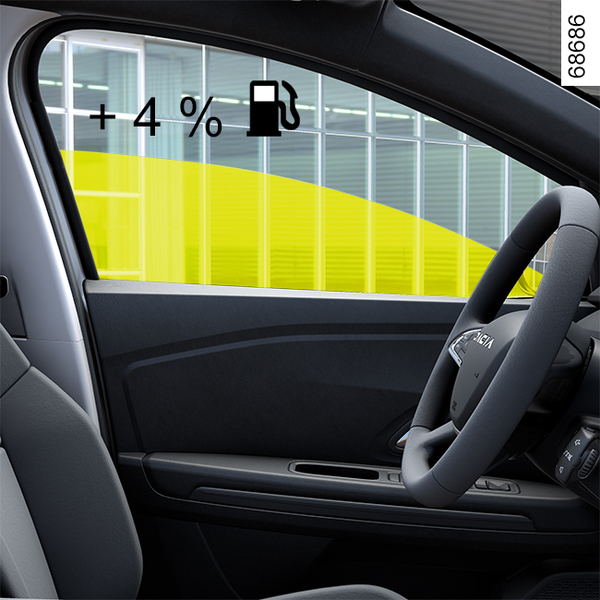
Advice on use
- Favour the ECO mode.
- Electricity is fuel – switch off all the electrical components when they are not genuinely needed. However (safety first), keep your lights on when the visibility is bad ("see and be seen").
- Use the air vents. Driving with the windows open at 62 mph (100 km/h) will increase fuel consumption by 4%.
- Never fill the fuel tank right to the brim to avoid overflow.
- On vehicles equipped with non-automatic air conditioning, switch off the air conditioning when it is not required.
Advice for reducing consumption and helping to preserve the environment:
- If the vehicle has been parked in the sun, open the doors for a few moments to let the hot air escape before starting the engine.
- Do not leave an empty roof rack fitted to the vehicle.
- It is better to fit a trailer for bulky objects.
- When towing a caravan, fit a wind deflector and adjust it carefully.
- Avoid using the vehicle for "door-to-door" calls (short journeys with long waits in between) because in such conditions the engine never reaches its optimal operating temperature.