New Dacia Spring
Rear parcel shelf
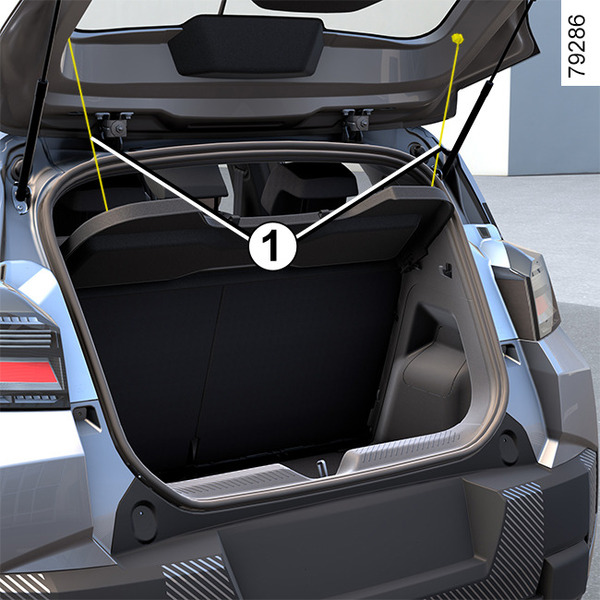
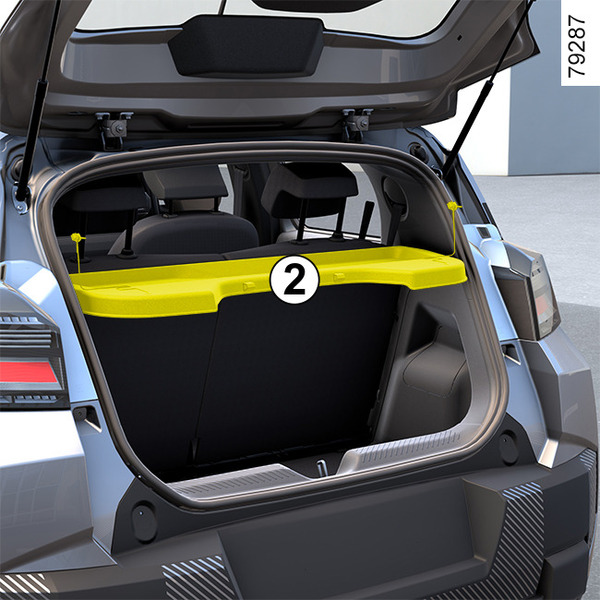
To remove it:
- lower the rear headrests;
- unhook the two suspension cords 1;
- lift the shelf 2 to unclip it;
tip
Maximum weight on the rear parcel shelf: 2 kg evenly distributed.
- push the shelf 2 inwards and turn it;
- pull the shelf towards you.
To refit, proceed in the reverse order to removal.
warning
Do not place any objects, especially heavy or hard objects, on the parcel shelf.
These may pose a risk to the vehicle occupants if the driver has to brake suddenly or if the vehicle is involved in an accident.
Charging lead storage tray
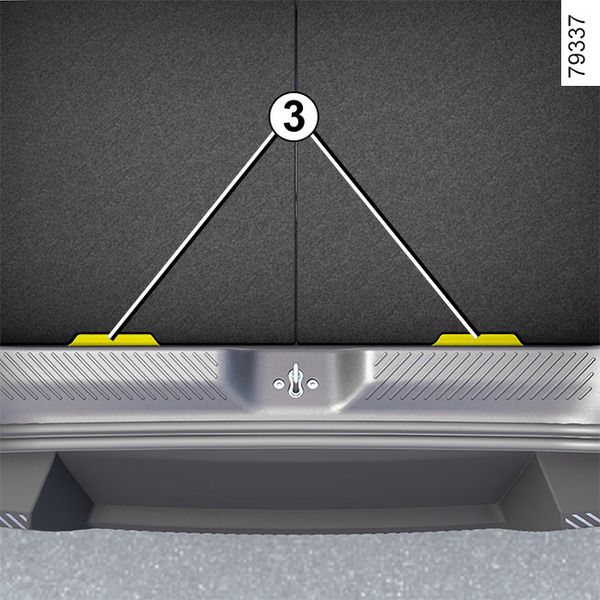
Depending on the vehicle, this tray is intended to store charging cables. The maximum permissible load per tray is 10 kg.
To access it, open the luggage compartment then raise the luggage compartment carpet using the handle 3 .
warning
If there is water in the charging lead storage tray, signs of corrosion or foreign bodies in the charging lead connector or in the vehicle charging socket, do not charge the vehicle.
Fire hazard.
Take care of the cable: do not tread on it, immerse it in water, pull on it or let anything knock against it.
Check and clean the storage tray regularly.
Transporting objects in the luggage compartment
Always position the objects transported so that the largest surface is against:
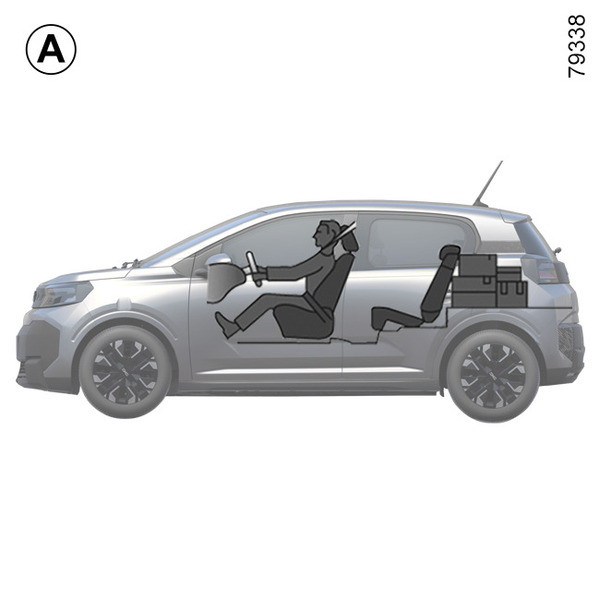
- The back of the rear seats, for normal loading (example A).
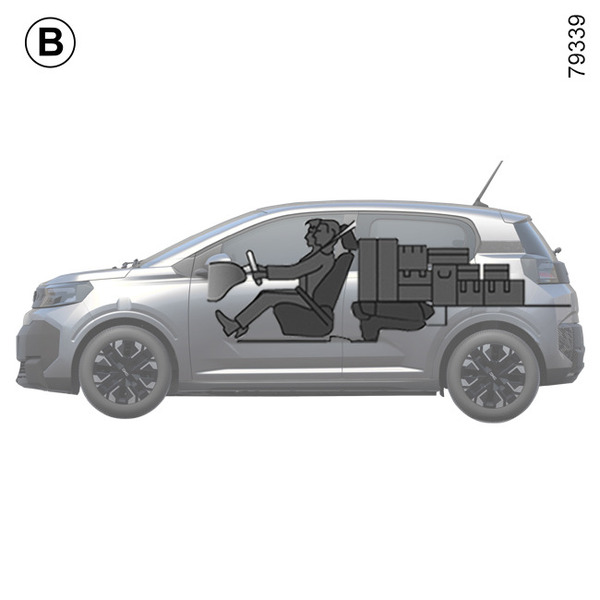
- the front seatbacks with the rear seatbacks folded down, as is the case for maximum loads (example B).
Ensure that the objects being transported are evenly distributed throughout the loading area.
If you have to place objects on the folded seat back, it is vital that you remove the headrests before folding the seat back so that it can be folded as flat as possible against the seat.
warning
When refitting the seatback, make sure it is correctly locked in place.
If seat covers are fitted, make sure these do not prevent the seatback latch from locking in.
Make sure that the seat belts are positioned correctly.
Reposition the headrests. The headrest is a safety component; check that it is fitted and in the correct position.
warning
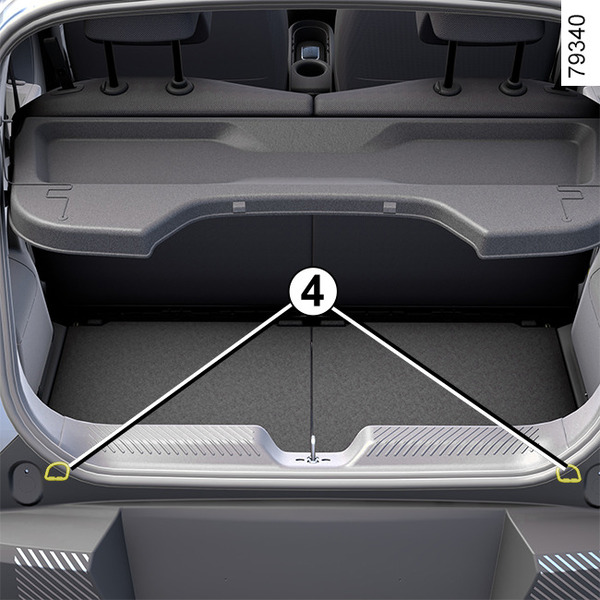
Always position the heaviest items directly on the floor. Use the lashing points 4 on the luggage compartment floor, if these are fitted to the vehicle. The luggage should be loaded in such a way that no items will be thrown forward and strike the occupants if the driver has to brake suddenly. Fasten the rear seat belts, even if the seats are not occupied.
Storage compartment 5 under the bonnet
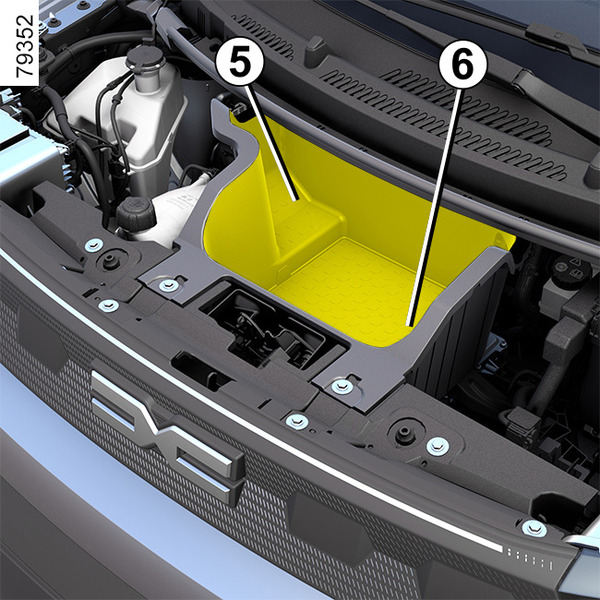
Depending on the vehicle, this storage compartment 5 is used to store various items, such as charging accessories (charging cable; VL2 connector, etc.).
To access the storage compartment 5 , open the bonnet. To open and close the bonnet Levels.
tip
Permitted load in the storage Compartment: 8 kg evenly distributed.
warning
The storage compartment has a drain plug 6 at the bottom. While cleaning compartment 5 do it carefully with sponge, not allowing liquids to flow on the electronic components. Avoid letting any debris go down the drain.
This risks damaging the electric circuit.
warning
Never leave your vehicle with the card inside.
warning
Do not store any chemicals items in the storage compartment. If any leak occurs it may damage the engine components.
Risk of damage or fire.
warning
If there is water in the charging lead storage tray, signs of corrosion or foreign bodies in the charging lead connector or in the vehicle charging socket, do not charge the vehicle.
Fire hazard.
Take care of the cable: do not tread on it, immerse it in water, pull on it or let anything knock against it. Check and clean the storage tray regularly.
Vehicles not fitted with storage compartment 5
warning
Due to the presence of motor:
- it is forbidden to store objects under the bonnet;
- when working on the engine compartment, ensure that you do not leave anything (cloths, tools, etc.) Otherwise, this may lead to engine damage or cause a fire
Risk of damage or fire;
- When working in the engine compartment, the mechanical components may be hot. The engine cooling fan may also start at any moment.
Risk of injury.