Dacia Jogger
General information
A combustion engine uses oil for lubrication and cooling of moving parts and it is normal to top up the level between scheduled oil changes.
However, contact your approved Dealer if more than 0.11 gal (0.5 litre) is being consumed every 600 miles (1,000 km) after the running in period.
Oil change frequency: check the oil level from time to time and certainly before any long journey to avoid the risk of damaging your engine.
Reading the oil level
The oil level should be read with the vehicle on level ground, after the engine has been switched off for some time.
The dipstick must be used to read the exact oil level and make sure that the maximum level has not been exceeded (risk of engine damage).
Depending on the vehicle, the instrument panel display only alerts the driver when the oil level is at its minimum.
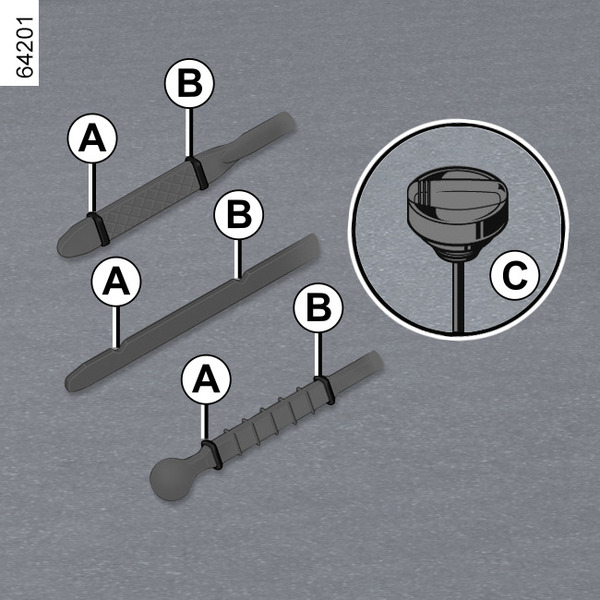
- Remove the dipstick and wipe with a clean, lint-free cloth;
- push the dipstick in as far as it will go (for vehicles equipped with a "cap-dipstick" C, screw the cap in as far as it will go);
- remove the dipstick again;
- read the level: it should never fall below the "minimum" mark A nor exceed the "maximum" mark B.
Once the operation has been completed, ensure that the dipstick is pushed in as far as it will go or that the "cap-type dipstick" is completely screwed in.
warning
Use a funnel or protect the filling neck area to avoid engine oil escaping onto a hot part of the engine compartment or a sensitive part (e.g. electrical components).
Fire hazard.
warning
Exceeding the maximum engine oil level
Under no circumstances should the maximum filling level B be exceeded: this could damage the engine and the emission control system. If the level exceeds the maximum level, do not start your vehicle and contact an authorised dealer.
Topping up, filling, oil change
Topping up/Filling
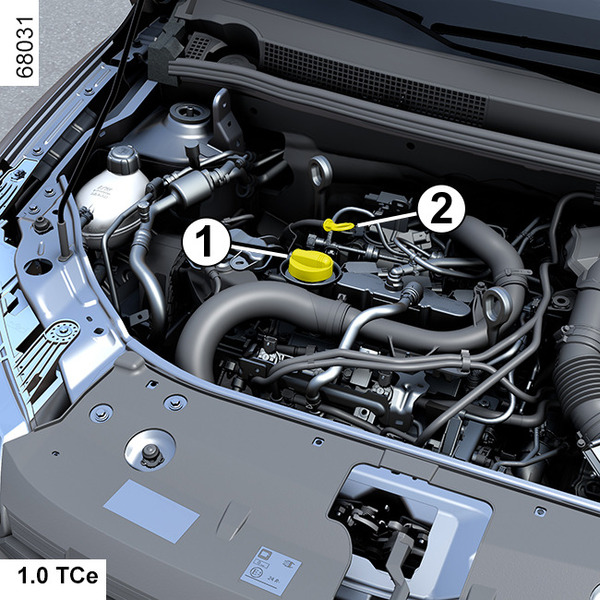
The vehicle must be parked on level ground and the engine should be stopped and cold (e.g. before the engine is started up for the first time that day).
warning
Before carrying out any action in the engine compartment, you must switch off the ignition Ignition-starter switch on a vehicle with key or Ignition-starter switch on a vehicle with card.
tip
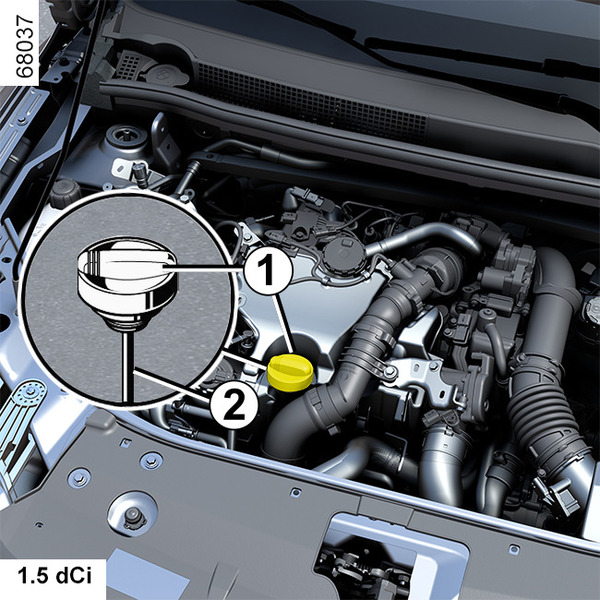
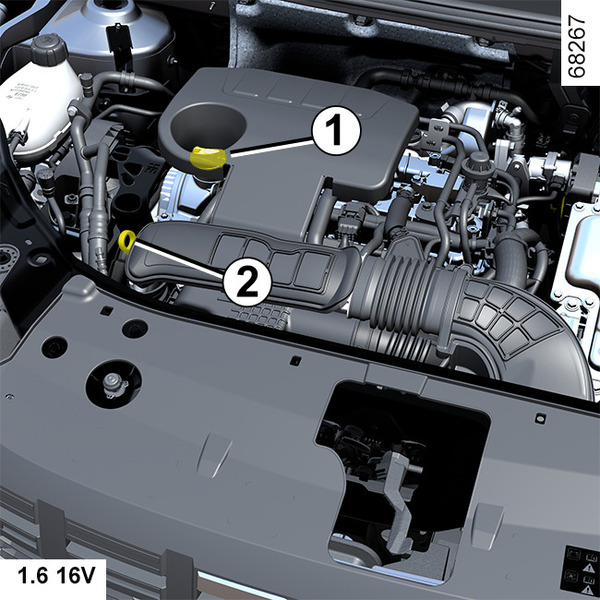
Do not exceed the "max" level and remember to refit the cap 1 and the dipstick 2.
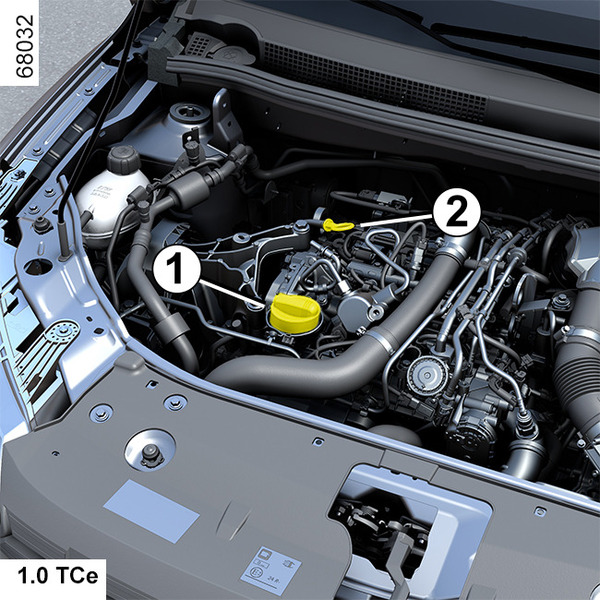
- Loosen the cap 1;
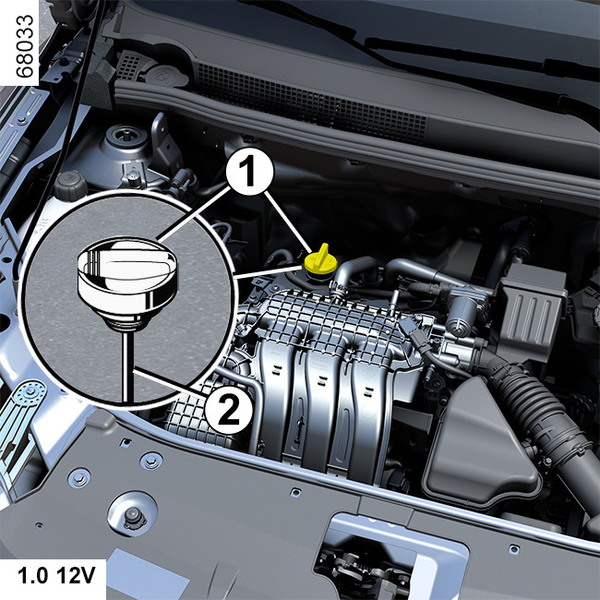
- top up the level (as a guide, the capacity between the "min" and "max" marks on the dipstick 2 is between 0.33 and 0.44 gal (1.5 and 2 litres), depending on the engine);
- wait for approximately 20 minutes to allow the oil to flow;
- check the level using the dipstick 2 (as described previously).
Once the operation has been completed, ensure that the dipstick is pushed in as far as it will go or that the "cap-type dipstick" is completely screwed in.
warning
Exceeding the maximum engine oil level
Under no circumstances should the maximum filling level be exceeded: this could damage the engine and the emission control system.
If the oil level exceeds the maximum level, do not start your vehicle and contact an approved dealer.
Oil change
Service interval: refer to the maintenance document for your vehicle.
Oil change capacity
Please refer to the maintenance document for your vehicle, or contact an authorised dealer.
Always check the engine oil level using the dipstick, as explained previously (it should never fall below the minimum level, or be over the maximum level on the dipstick).
Engine oil grade
Refer to the maintenance document for your vehicle.
warning
Adding engine oil
Use a funnel or protect the filling neck area to avoid engine oil escaping onto a hot part of the engine compartment or a sensitive part (e.g. electrical components).
Fire hazard.
warning
Never run the engine in an enclosed space as exhaust gases are poisonous.
warning
When working in the engine compartment, ensure that the windscreen wiper stalk is in the park position.
Risk of injury.
warning
Filling and/or checking the oil level: when topping up or checking the oil level, ensure that no oil leaks onto the engine components.
Do not forget to properly close the cap and refit the dipstick to prevent any oil spatter on hot engine components.
Fire hazard.
warning
Please note when working close to the engine that it may be hot. The engine cooling fan may also start at any moment. The
 label in the engine compartment reminds you of this.
Risk of injury.
tip
If there is an abnormal or repeated drop in the fluid level, consult an approved dealer.
warning
Engine oil change: if you are changing the oil when the engine is hot, be careful not to scald yourself as the oil drains.