Dacia Duster
Petrol and diesel versions
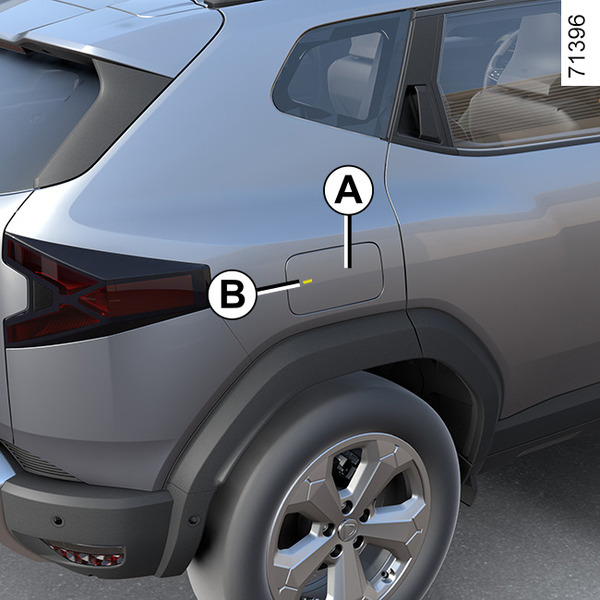
Useable capacity of the tank:
- About 11 gallons (50 litres) for 4x2 versions.
- About 12.1 gallons (55 litres) for 4x4 versions.
With the vehicle unlocked, to open the fuel flap A press zone B then release it. Open it, then unscrew the fuel filler cap 1.
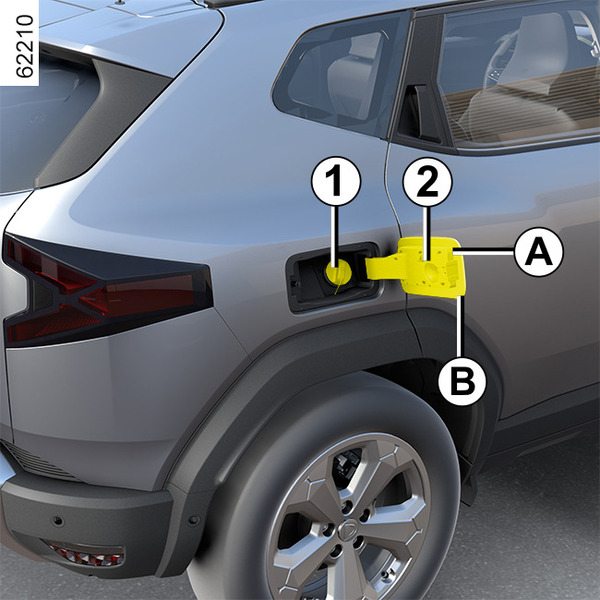
There is a cap holder 2 on the filler flap for holding the cap when the tank is being filled.
To close it, press the fuel filler flap A by hand, as far as it will go. Depending on the vehicle, cap 1 is connected to the vehicle by a plastic wire. For details on filling the tank, refer to the information on "Filling with fuel".
warning
Fuel filler cap: this is a specific type. If you have to replace it, make sure the new cap is of the same type as the original. Contact an approved Dealer.
Never place the cap near a source of heat or flame.
Do not wash the filler area with a high-pressure washer.
Fuel grade
Always use a high-grade fuel that complies with the legislation in force in each country. It must conform to the specifications given on the label on the fuel filler flap Engine specifications.
Petrol version
It is essential to use unleaded petrol. The octane rating (RON) should match the information shown on the label located inside the fuel filler flap Engine specifications.
Diesel version
It is essential to use diesel that conforms to the specifications given on the label inside the fuel filler flap Engine specifications.
tip
Fuels that comply with the European standards with which vehicle engines marketed in Europe are compatible Engine specifications.
warning
To fill up with fuel, the engine must be switched off (and not only on standby in the case of vehicles equipped with the Stop and Start function): you must switch off the ignition Ignition-starter switch on a vehicle with key, Ignition-starter switch on a vehicle with card.
Fire hazard.
warning
Do not mix even small amounts of petrol (unleaded or E85) with diesel.
Do not use ethanol-based fuel if your vehicle is not compatible with this fuel.
Do not add reagent to the fuel – otherwise you risk damaging the engine . If you wish to add an additive to the fuel, use a product approved by our Technical Department.
Consult an approved Dealer.
warning
No modifications whatsoever are permitted on any part of the fuel supply system (electronic unit, wiring, fuel circuit, injector, protective covers, etc.) as this may be dangerous (unless undertaken by qualified Network personnel).
warning
Please note when working close to the engine that it may be hot. The engine cooling fan may also start at any moment. The
 label in the engine compartment reminds you of this.
Risk of injury.
Filling with fuel
With the ignition off, insert the nozzle to fill the fuel tank (avoid the risk of splashing).
Keep the nozzle in this position throughout the entire filling operation. When the pump cuts out automatically at the end of the filling procedure, a maximum of two further filling attempts may be made, as there must be sufficient space in the fuel tank to allow for expansion.
Make sure that no water enters the fuel tank during filling.
After filling, refit the cap 1 and close the filler flap A to avoid any water or foreign bodies from entering the system.
Always make sure that the cap 1, the flap A and its perimeter remain clean and free of dust, mud, dirt, etc.
Special case
When the vehicle has been stopped for around three months, you must add fuel to prevent damage to the fuel pump.
To do this, with the ignition off, fill up with fuel or add at least approximately 2.20 gallons (10 litres), then start the engine to operate the pump and renew the fuel in the circuit.
If it is not possible to add at least 1.10 gallons (5 litres) of fuel due to the fuel level in the tank, drive the vehicle until the tank has capacity.
Petrol version
Using leaded petrol will damage the antipollution system and may lead to a loss of warranty.
To ensure that the fuel tank is not filled with leaded petrol, the fuel tank filler neck contains a restrictor fitted with a foolproof system which only allows the nozzle for unleaded petrol to be used (at the pump).
warning
Persistent smell of fuel
If you notice a persistent fuel odour you should:
- stop the vehicle when traffic conditions allow it and switch off the ignition;
- switch on the hazard warning lights and ask your passengers to leave the vehicle and stay clear of the traffic;
- contact an authorised dealer.