Dacia Spring
Schematic diagram
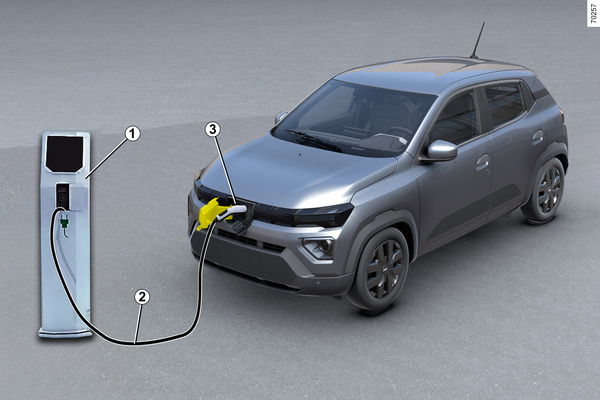
- 1
- Specific wall socket or recharging terminal.
- 2
- Charging cable.
- 3
- Electric charging connection.
tip
If you have any questions regarding the equipment needed for charging, please ask an authorised dealer.
warning
Important recommendations for charging your vehicle
Please read these instructions carefully. Failure to follow these instructions may lead to a risk of fire, serious injury or electric shocks which could result in death.
Charging
Do not do anything to the vehicle during charging (washing, working in the engine compartment etc.).
In the event of the presence of water, signs of corrosion or foreign bodies in the charging cable connector or in the vehicle charging socket, do not charge the vehicle. Fire hazard.
Do not attempt to touch the cable contacts, the domestic socket or the vehicle charging socket, or introduce objects into them.
Never plug the charging cable into an adapter, multiple socket or extension cable.
The use of generators is prohibited.
Do not remove or change the vehicle charging socket or the charging cable. Fire hazard.
Do not modify or perform any action on the installation during charging.
In the event of an impact, even slight, against the charging flap or the electric charging connection with charging cable plugged, have them checked by an authorised dealer as soon as possible.
Take care of the cable : do not tread on it, immerse it in water or pull on it or let anything knock against it.
Check regularly that the charging cable is in good condition.
In the event of damage to the charging cable (corrosion, browning, cuts, etc.), to the unit or to the vehicle’s electrical charging socket, do not use them. Please see an authorised dealer to replace them.
In the event of non-activation of the charging flap locking mechanism and/or unlocking of the vehicle’s electric charging socket, please contact an approved dealer.
Charging cable A
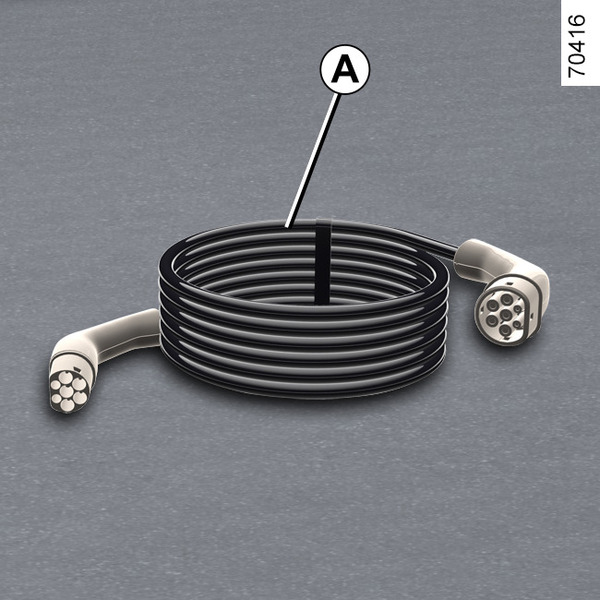
This cable is specific to your vehicle and designed for connecting to wall sockets or public terminals to enable charging of the traction battery.
Charging cable B
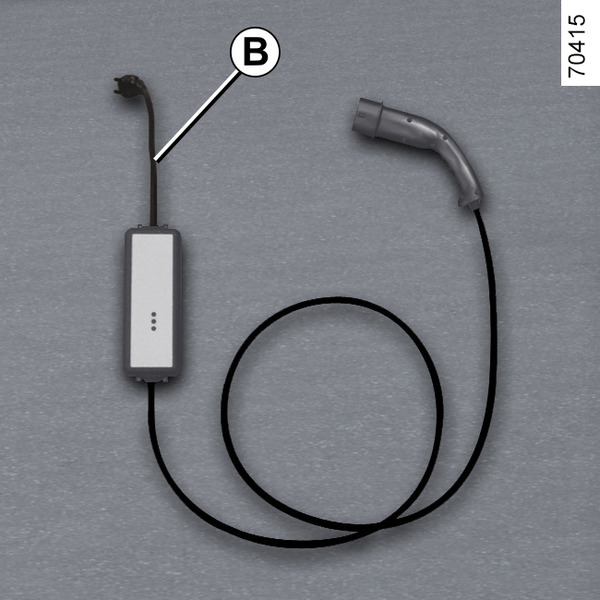
To charge your vehicle, this cable can be used:
- with a domestic socket-outlet (8 A/ 10 A charging), for example, when you're not at home.
In all cases, sockets must be fitted as stated in the instructions provided with the charging cable B.
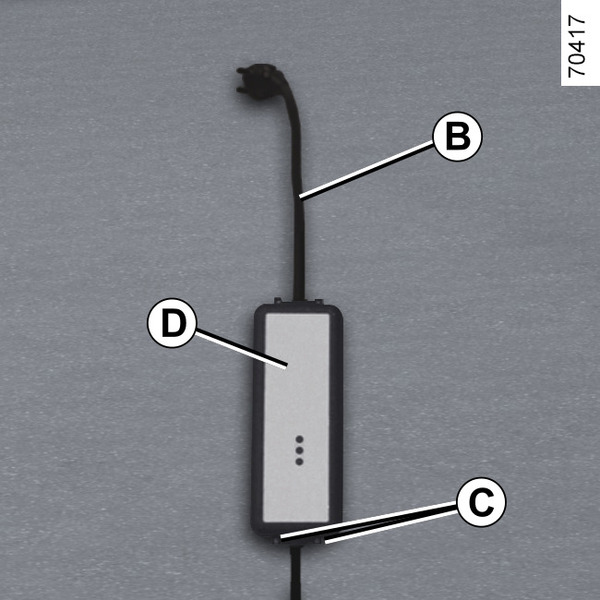
In all cases, read the charging cable B user instructions carefully.
tip
Never leave the socket hanging by the cable. Use the hooks C to attach it.
tip
If a malfunction occurs during the charging process (red warning light appears on the unit D), stop charging immediately. Please refer to charging cable instructions.
tip
Before cleaning the charging cable, make sure the cable is disconnected.
Clean the cable using a cloth slightly dampened with water.
When cleaning, make sure that the cloth does not come into contact with the ends of the cable (connectors, charging pins) to avoid any risk of corrosion.
tip
Each charging cable is stored in the luggage compartment of the vehicle Boot.
Important recommendations
warning
Important recommendations for charging your vehicle
Please read these instructions carefully. Failure to follow these instructions may lead to a risk of fire, serious injury or electric shocks which could result in death.
Choice of charging cable
The standard charging cables supplied with the vehicle have been designed specifically for this vehicle. It is designed to protect you against the risks of electric shock that can lead to death or fire.
Do not use with the charging cable of previous vehicles as they are not adapted.
For safety reasons, the use of a charging cable not recommended by the manufacturer is strictly forbidden. Failure to follow this instruction can lead to risks of fire or electric shock that can prove fatal. For information on a charging cable suited to your vehicle, please consult an authorised dealer.
Using the charging cable B
Please read the instructions that come with the charging cable carefully to learn about precautions you must take when using the product and the technical specifications required when fitting the socket.
Installation
Wall socket
Have a special wall socket installed by a qualified professional.
In the case of domestic charging
Have a qualified professional check that each socket to which you will connect the charging cable complies with the standards and regulations in force in your country and that it complies with the specifications described in the information on « Power supply systems ».
Power supply systems
Only use charging terminals which conform to the IEC 61851-1 standard and connecting points protected by :
- a Type A 30 mA residual current device specific to the socket used;
- an overcurrent protection device;
- protection against overvoltage relating to lightning in exposed areas (IEC 62305-4);
- an earth connection that complies with the standards in the relevant country.
Charging types that conform to European standards
Alternating current (AC)
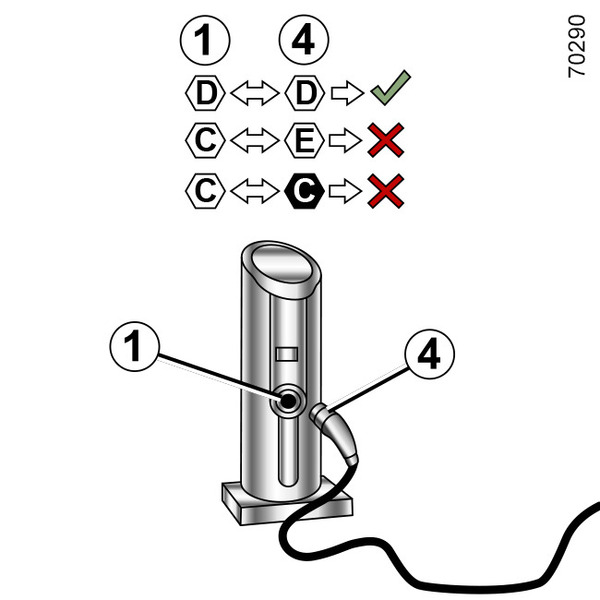
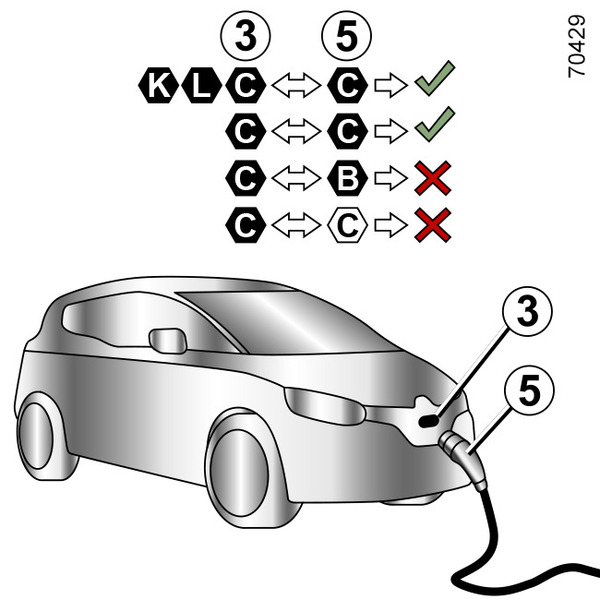
If the information is displayed on the vehicle charging flap, follow the instructions below.
Before plugging in a charging cable, check that:
- the colour and one of the letters of the inlet socket 1 correspond to the colour and one of the letters on the end 4 of the cable;
- the colour and one of the letters of the inlet socket 3 correspond to the colour and one of the letters on the end 5 of the cable.
Labels
Charging type | Alternating current (AC) | ||||
|---|---|---|---|---|---|
Connection | Charging terminal 1/Charging cable 4 | Vehicle 3/Charging cable5 | |||
Charging types that conform to European standards (for all other cases, please consult an approved dealer). |
|
|
|
|
|





Charging types that conform to European standards
Direct current (DC)
If the information is displayed on the vehicle charging flap, follow the instructions below.
Before plugging in a charging cable, make sure that the colour and one of the letters of the inlet socket 3 correspond to the colour and one of the letters on the end 5 of the charging cable.
Labels
Charging type | Direct current (DC) | ||||
|---|---|---|---|---|---|
Connection | Vehicle 3/Charging cable 5 | ||||
Charging types that conform to European standards (for all other cases, please consult an approved dealer). |
|
|
|
|
|





Electric Charging connection 3
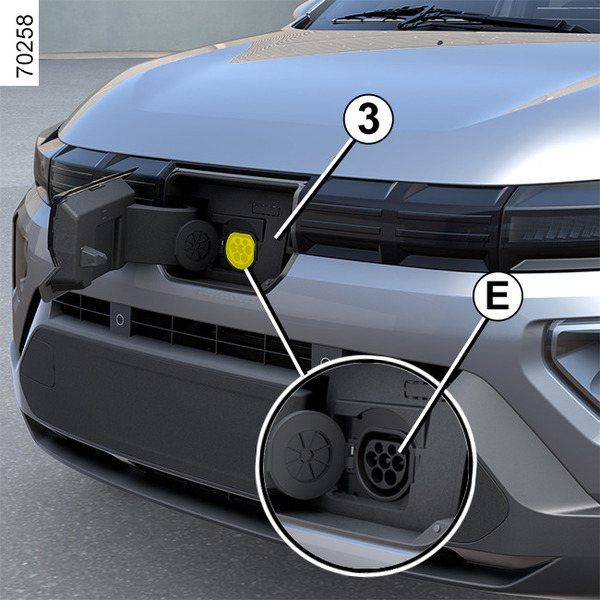
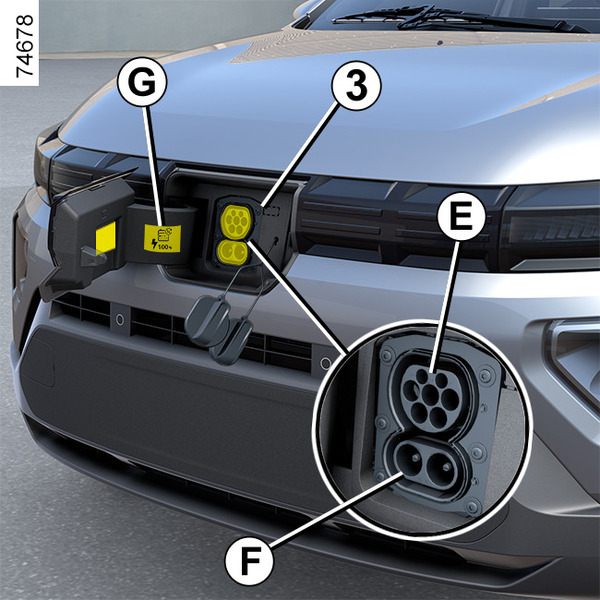
The vehicle is equipped with two charging connections located at the front of the vehicle :
- E socket for charging up to 7 kW in alternating current (AC) ;
- F socket depending on the vehicle, for rapid charging in direct current (DC).
Note: If in a snowy environment, remove snow from the vehicle charging area before plugging in or disconnecting. Snow in the socket may block the insertion of the charging cable plug.
tip
Depending on the vehicle, sockets E and F are protected by a blanking covers. Before plugging a charging cable into the socket :
- E, make sure that the blanking cover on socket F is in place;
- F, remove the blanking cover from socket E.
Label G
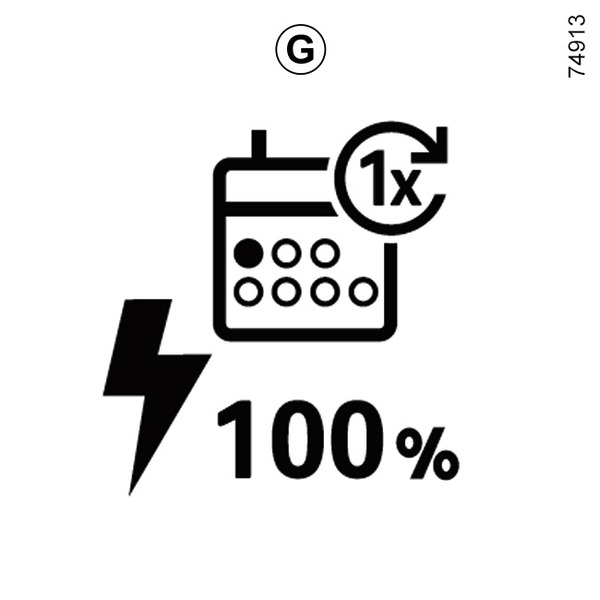
To ensure proper battery charge status management and accurate dashboard display of remaining range: charge your vehicle to 100% once a month or every 1,000 km.
Precaution:
- You do not have to wait until the traction battery hits the reserve level in order to recharge it.
- Charging times vary depending on the type of specific wall unit socket or public terminal you connect to.
- Charging can be performed in the rain or snow.
- Activating the air-conditioning increases the charge time required.
- The energy level available depends on the battery temperature. it may therefore vary between stopping and restarting the vehicle if the battery is cold or warm.
- If the vehicle is parked for more than three months with near zero charge, it may become impossible to charge the battery.
Under extreme weather conditions
- In high temperatures, try to park and recharge the vehicle in a shaded/covered location;
- In cold weather, the charging time might be overestimated at the beginning of the charge.
- Avoid charging and parking your vehicle in extreme temperatures (hot or cold).
- Under extreme conditions, charging may take several minutes before starting (time required for the traction battery to cool down or warm up).
- It is preferable to recharge the vehicle after driving if the charge level is low (<25%) and in negative temperatures.
- When the vehicle is parked for more than seven days in temperature below approximately -25°C, charging the traction battery can become impossible.
Recommendations
- To preserve the lifespan of your traction battery:
- for daily trips, prefer charging up to a maximum of 80%;
- Avoid parking your vehicle for more than one month with a high state of charge (above approximately 50%), especially during periods of high temperatures.
- Favour charging the traction battery after driving and/or in mild temperatures. Otherwise, charging may take a longer period of time or even become impossible.
tip
In the absence of any protection against over voltage, you are recommended not to charge the vehicle in stormy weather (lightning, etc.).
Recharging the traction battery
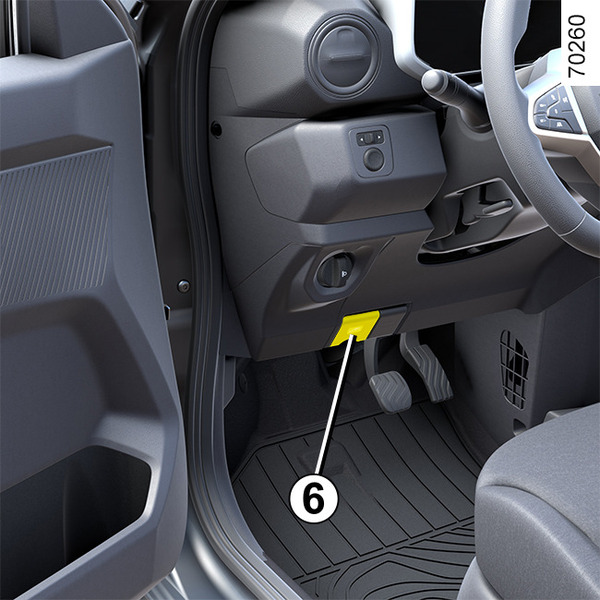
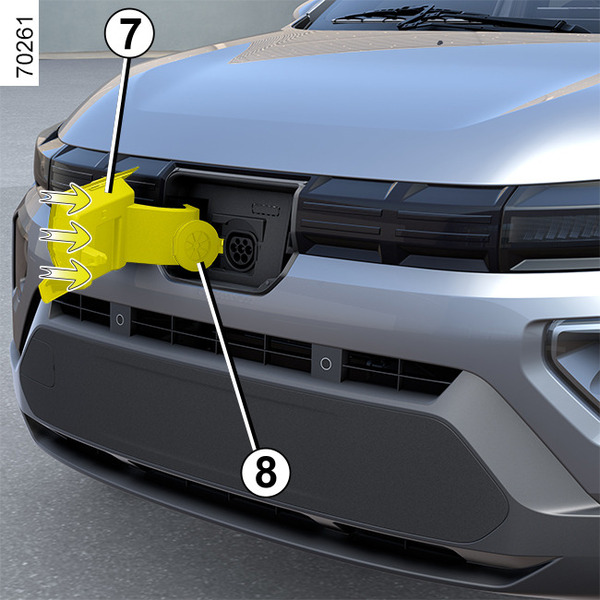
Vehicle stationary, opening element unlocked, ignition off:
- take the charging cable located in the boot of your vehicle;
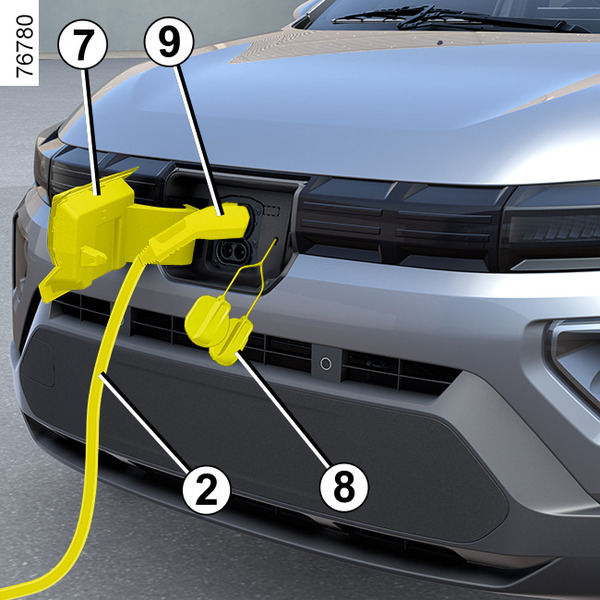
- pull the 6 button to unlock the charging flap 7. If the charging flap 7 not opening after pull the 6 button due to icing, recommending to hit the flap on the mentioned zone/direction by the hand to remove ice and try again;
- remove cap 8. Plug in the end of the cable to the power supply;
- grab the handle 9;
- plug in the vehicle cable.
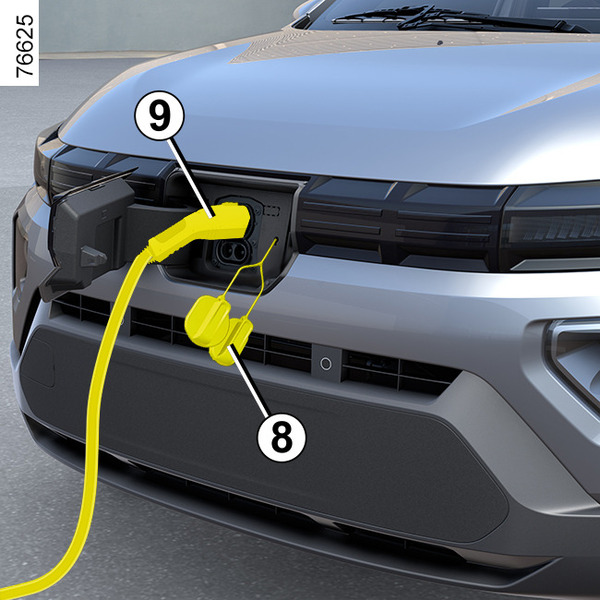
- check that the charging cable is properly plugged in. Before the charging starts, the plug lock will be active;
- the charging cable is automatically locked with the vehicle. This will make it impossible to unplug the cable from your vehicle.
Note: do not pull on the handle 9 during the locking of the charging cable to the vehicle.
tip
Make sure that the hand brake is applied always whenever the vehicle is in charging condition.
tip
If rapid charging (DC) the length of the charging cable between your vehicle and the charging station must not exceed 30 metres.
In case of doubt about the length of the cable, consult the owner of the charging station (DC).
tip
Make sure you fully uncoil the charging cable to limit its heating.
warning
Do not use an extension cable, multiple socket or adapter.
Fire hazard.
When charging starts, the following information is displayed on the instrument panel:
- the energy level on the battery warning light 10;
tip
The traction battery charging time depends on the amount of energy remaining and the power delivered by the charging terminal. The information is displayed on the instrument panel during charging Displays and indicators.
Note: under certain conditions, the actual charging time may be longer than the charging time displayed on the instrument panel. This depends on:
- the quality of the electrical network;
- the initial charge level;
- the exterior temperature is too cold;
- ...
In the event of a problem with the charging cable, we recommend that you replace it with a cable that is identical to the original. Consult an approved dealer.
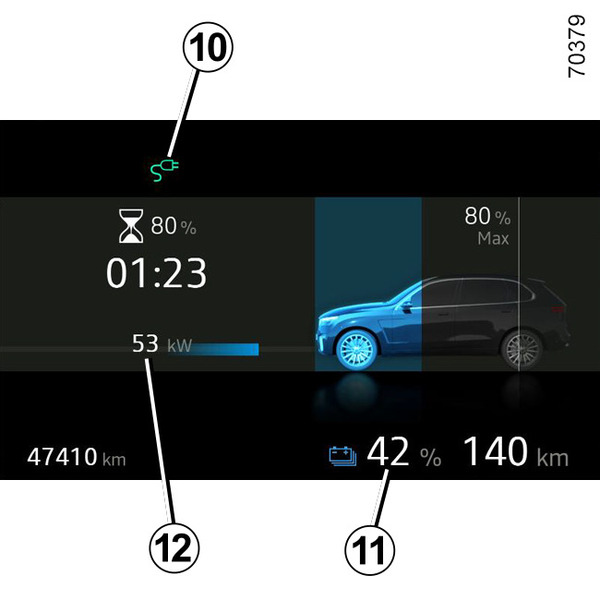
- the battery refill rate;
- an estimate of the remaining charging time (this is not displayed after the battery is charged to approximately 95%);
- the warning light 10 indicates that the vehicle is connected to a power supply;
- the power supply entering the vehicle 12;
- your vehicle range will vary according to the charge level.
The display on the instrument panel disappears after a few seconds. It reappears on the instrument panel when a door is opened.
Once charging is complete, the warning light 10 illuminates continuously in green.
You do not need to wait until the charge is at reserve levels to recharge your vehicle.
Operating faults
If the warning light 11 blinks continuously in red, please contact an approved dealer.
Precautions to take when removing from socket;
It is imperative to follow the unplugging steps in order:
- to unlock the vehicle charging cable and stop charging;
- press the operating elements unlocking button on the remote control key;
or
- press the interior locking and unlocking door control Locking, unlocking the opening elements and doors;
- grab the handle 9 and unplug the charging cable from the vehicle ;
- put cap 8 back ;
- close the charging flap 7 with both hands and press on it in order to lock it ;
- unplug the cable from the power supply;
- place the cable 2 in the luggage compartment.
Note:
- Immediately after a long charge of the traction battery, the cable may be hot. Please use the handles.
- depending the situation, if the vehicle charging cable is still locked after pressing the unlocking button on the remote control, repeat the operation by pressing the unlocking button twice consecutively. One, to stop the charge and one to allow the unlocking of the handle 9.
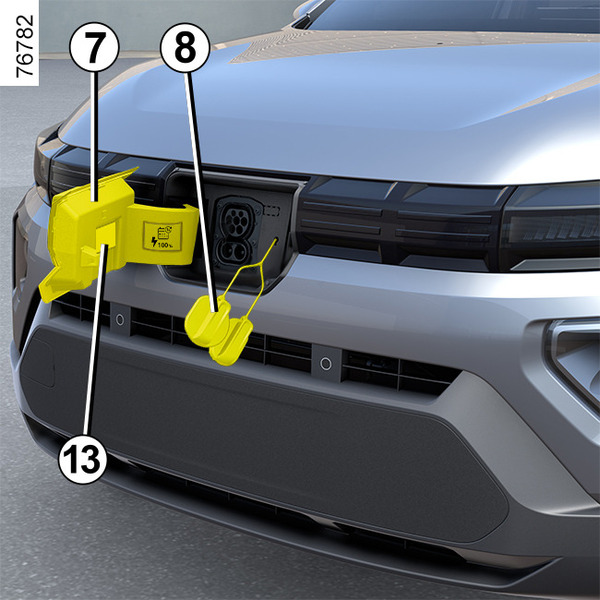
Label 13
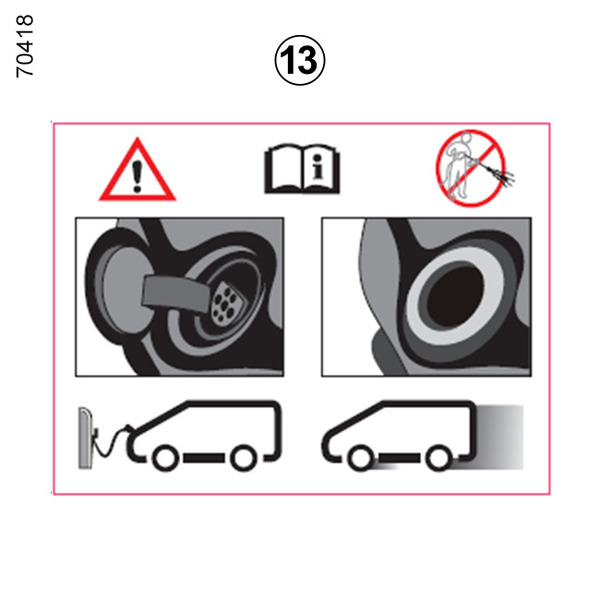
The label 13 located on the right-hand side reminds you of the following instructions:
- do not wash the charging flap using a high-pressure water jet;
- with the vehicle stationary, the valve and the charging flap can be opened;
- when the vehicle is being driven, the valve and the charging flap must be closed;
- open the flap to connect the charging cable;
- close the flap again once disconnected;
- connect to a domestic socket, an alternating current charging terminal or a quick charging terminal;
- For any information on charging, please consult your vehicle user manual.
tip
Do not drive the car with the charging flap 7 open condition. Once the charging cable is unplugged from the vehicle, make sure that the cap 8 is put and the charging flap 7 is properly closed.
tip
At the end of charging, unplug the cable from the vehicle first, before unplugging it from the domestic socket.
tip
After pressing the unlocking button on the radio frequency remote control or the interior locking/unlocking door control Locking, unlocking the opening elements and doors, you have 30 seconds to unplug it before it locks again and charging resumes.
tip
The traction battery charging time depends on the amount of energy remaining and the power delivered by the charging terminal. The information is displayed on the instrument panel during charging Displays and indicators.
In the event of a problem, we recommend that you replace it with an identical cable. Please see an authorised dealer.
tip
In alternative current (AC) charging mode
- depending on the charging station, remote charge stop and resume function possible during a charge;
- the charging can be stopped and the charging plug unlocked by pressing the unlock button in the radio frequency key or by pressing the interior locking/unlocking door control Locking, unlocking the opening elements and doors.
tip
In direct current (DC) charging mode
- depending on the vehicle and the charging station, remote charge stop possible but resume function not possible during a charge;
- the charging can be stopped and the charging plug unlocked only with the recharging terminal. By pressing the unlock button of the radio frequency key or by pressing the interior locking/unlocking door control Locking, unlocking the opening elements and doors, the charging will not gets stopped.