Dacia Bigster
Depending on the vehicle, they may include:
- the anti-lock braking system (ABS);
- of the electronic stability program (ESC) with understeer control and traction control;
- the emergency brake assist function with, depending on the vehicle, braking anticipation;
- hill start assistance;
- multi-collision braking.
- the regenerative braking system
- deceleration speed control;
warning
These functions are an additional aid in the event of critical driving conditions, enabling the vehicle behaviour to be adapted to suit the driving conditions. The functions do not take the place of the driver. They do not increase the vehicle's limits and should not encourage you to drive more quickly. Therefore, they can under no circumstances replace the vigilance or responsibility of the driver when manoeuvring the vehicle (the driver must always be ready for sudden incidents which may occur when driving).
Anti-lock braking system ( ABS )
Under heavy braking, the ABS prevents the wheels from locking, allowing the stopping distance to be managed and keeping control of the vehicle.
Under these circumstances, the vehicle can be steered to avoid an obstacle whilst braking. In addition, this system can increase stopping distances, particularly on roads with low surface grip (wet ground etc.).
You will feel a pulsation through the brake pedal each time the system is activated. The ABS does not in any way improve the vehicle’s "physical" performance relating to the road surface and roadholding. It is still essential to follow the rules of good driving practice (such as driving at a safe distance from the vehicle in front etc.).
Special feature of 4-wheel drive vehicles
In "OFF-ROAD" (LOCK) mode, the system may lock the wheels briefly to optimise the braking distance on very soft ground (snow, mud, sand, etc.).
tip
In an emergency, apply firm and continuous pressure to the brake pedal. There is no need to pump it repeatedly. The ABS will modulate the force applied in the braking system.
Operating faults:
-
 and
and
 lit up on the instrument panel accompanied by the "Check ABS", "WARNING: Check Braking System" and "Check ESC" messages: this indicates that the ABS, the ESC and the Emergency Brake Assist functions are deactivated. Braking is still provided;
 -
,
 ,
and
,
and
 lit on the instrument panel accompanied by the "WARNING: Braking System" message: this indicates a fault with the braking system.
In both cases, please contact an Approved Dealer.
warning
For your own safety, the
warning light requires you to stop immediately, as soon as traffic conditions allow. Switch off the engine and do not restart it. Call an Approved Dealer.
warning
Your braking systems are partially operational. However, it is dangerous to brake suddenly and it is essential to stop immediately, as soon as traffic conditions allow. Call an Approved Dealer.
Emergency brake assist with electronic brake distribution
This system supplements the ABS and helps reduce vehicle stopping distances.
Operating principle
The system is for detecting an emergency braking situation. In this case, the braking assistance immediately develops maximum power and may trigger ABS regulation.
ABS braking is maintained as long as the brake pedal is applied.
Electronic stability control ( ESC ) with understeer control and traction control
Electronic Stability Control (ESC)
This system helps you to keep control of the vehicle in critical driving situations (avoiding an obstacle, loss of grip on a bend, etc.).
Operating principle
A sensor at the steering wheel makes it possible to determine the driving trajectory desired by the driver.
Other sensors throughout the vehicle measure the actual trajectory.
The system compares driver input to the actual trajectory of the vehicle and corrects the trajectory if necessary by controlling the braking of certain wheels and/or engine power. In the event that the system is engaged, indicator light
 flashes on the instrument panel.
Operating faults
If the system detects an operating fault, the
and
warning lights appear on the instrument panel and, depending on the vehicle, the "Check ESC" message is displayed on the instrument panel. In this case, the electronic stability program ESC with understeer control and traction control are deactivated.
Consult an approved Dealer.
Understeer control
This system optimises the action of the ESC in the case of pronounced understeering (loss of front axle road holding).
Traction control
This system helps to limit wheelspin of the drive wheels and to control the vehicle when pulling away, accelerating or decelerating on slippy roads.
Inhibition of theESC
(depending on the vehicle)
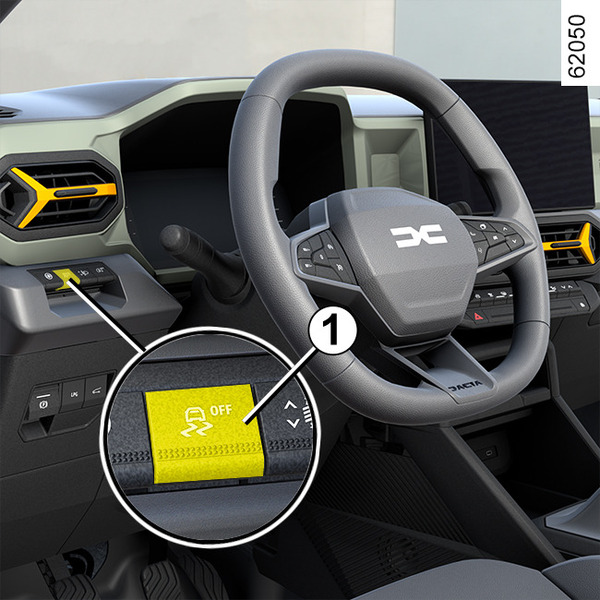
In certain situations (closed road or circuit, etc.), these functions can be deactivated by pressing and holding switch 1.
The
 warning light and the "ESC OFF" message are displayed on the instrument panel to warn you.
You can reactivate these functions at any time by briefly pressing the switch 1.
Note: the system is automatically reactivated:
- when the vehicle is started again;
- when the driving mode is changed Transmission: 4-wheel drive.
If the warning light does not appear on the instrument panel, this confirms that the system is once again activated.
warning
Deactivating the ESC will make the driving aid functions (Active Emergency Braking, etc.) unavailable.
Disabling and activating the traction control
(depending on the vehicle)
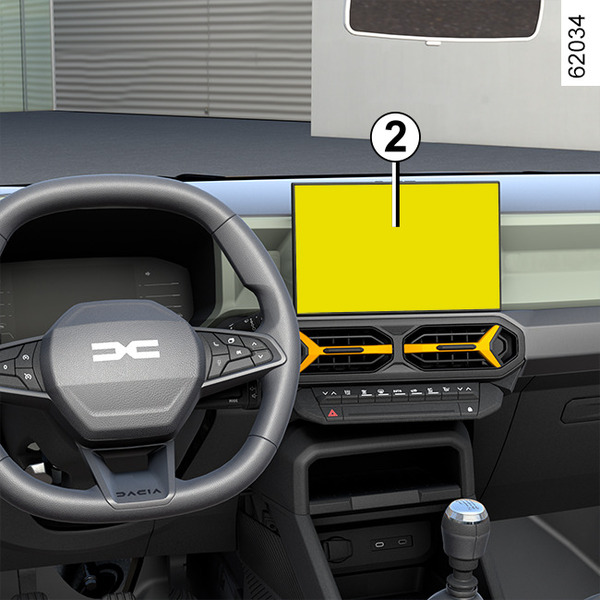
When starting on snow, ice or soft ground (mud, sand, gravel), the traction control system can be deactivated from the multimedia screen 2.
When the system is deactivated, the
warning light appears on the instrument panel.
Please refer to the multimedia instructions for more information.
Note: the system is automatically reactivated:
- when the vehicle speed exceeds approximately 31 mph (50 km/h);
- when the vehicle is started again.
If the warning light does not appear on the instrument panel, this confirms that the system is once again activated.
warning
Deactivating of the traction control function causes temporary unavailability of certain driving aid functions (Active Emergency Braking, etc.).
Hill start assistance
Depending on the gradient of the incline, this system assists the driver when starting on a hill. It prevents the vehicle from rolling backwards by automatically applying the brakes when the driver lifts his/her foot off the brake pedal to depress the accelerator pedal.
System operation
It only operates when the gear lever is in a position other than neutral (other than N or P on an automatic gearbox) and the vehicle is completely stationary (brake pedal pressed).
The system holds the vehicle for approximately 2 seconds. The brakes are then released (the vehicle will move according to the slope).
If the system detects an operating fault, the
warning light and, depending on the vehicle, the "Check Hill Start Assist" message is displayed on the instrument panel. Consult an approved Dealer.
warning
The hill start assistance system cannot completely prevent the vehicle from rolling backwards in all situations (extremely steep gradients etc.).
In all cases, the driver may depress the brake pedal to prevent the vehicle from rolling backwards.
The Hill Start Assist function should not be used for prolonged stops: use the brake pedal.
This function is not designed to immobilise the vehicle permanently.
If necessary, use the brake pedal to stop the vehicle.
The driver must remain particularly vigilant when driving on slippery or low-grip surfaces.
Risk of serious injury.
Hill Descent Control
(vehicles equipped with an automatic gearbox)
This function enables the vehicle speed to be limited without depressing the brake pedal (when driving down a steep hill).
When driving forwards or in reverse (D or R position) and when the system detects a slope, you can automatically maintain your vehicle's speed by releasing the accelerator or brake pedal.
Activation/deactivation from the multimedia screen 2
Depending on the vehicle, with the ignition on, you can activate/deactivate the system via the multimedia screen 2.
Please refer to the multimedia instructions for further information.
Activating/deactivating using the button 3
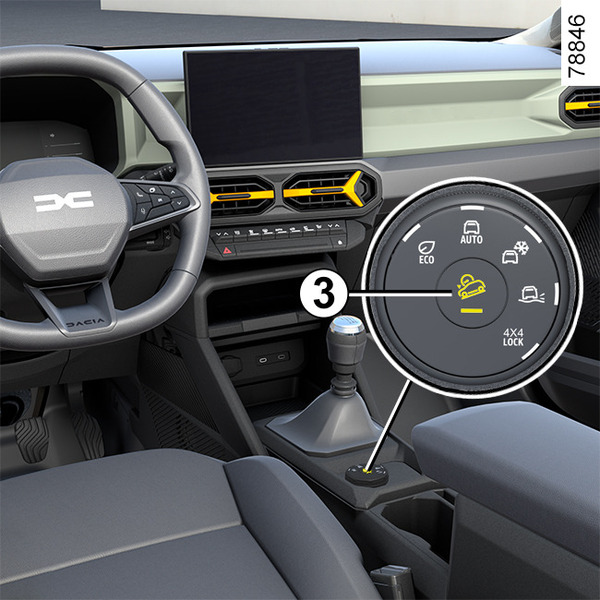
- Activation: press the button 3. The
 warning light is displayed in white on the instrument panel.
 - Deactivation: press the button 3 again. Warning light
goes out.
The function is ready to intervene between approximately 2 and 37 mph (4 and 60 km/h) as soon as the system detects a slope.
Note: if the vehicle speed is above approximately 37 mph (60 km/h), the system is deactivated and the
warning light disappears.
tip
This system does not operate if the gear lever is in P position on vehicles fitted with an automatic gearbox, or if the vehicle is travelling on flat ground.
Operation
The function intervenes when the vehicle speed is between approximately 2 and 19 mph (4 and 30 km/h):
- the
warning light is displayed in green on the instrument panel;
- release the accelerator pedal or press the brake pedal to maintain the speed displayed on the instrument panel.
Note: during activation of the hill descent control system, the vehicle speed can be increased using the accelerator pedal or decreased using the brake pedal.
The function does not intervene when the vehicle speed is between approximately 19 and 37 mph (30 and 60 km/h):
the
warning light is displayed in grey on the instrument panel. The downhill speed is not adjusted when you release the accelerator pedal or press the brake pedal.
warning
In the event of a fault on the vehicle hill descent control, use the brake pedal to stop the vehicle.
The driver must remain particularly vigilant when driving on slippery or low-grip surfaces.
Risk of serious injury.
Multi-collision braking
Multi-collision braking reduces the risk of an additional collision after an accident by temporarily bringing your vehicle to a standstill.
Operating principle
If the airbag system detects a collision, the pretensioners or the airbags are triggered Methods of restraint in addition to the front seat belts and the "Multi-collision braking" function activates the Electronic Stability Control (ESC) to brake the vehicle.
Multi-collision braking is deactivated during operation if:
- the driver presses the accelerator pedal firmly;
and/or
- the braking force generated by the driver pressing the brake pedal is greater than the force produced by the automatic braking triggered by the function.
Note: multi-collision braking requires the proper functioning of your vehicle's braking system.
Operating faults
When the system detects an operating fault, the "Check Post-collision" message and the
warning light appear on the instrument panel.
In this case, the function is deactivated. Consult an approved Dealer.