Dacia Bigster
tip
Remember that driving a vehicle off-road is very different to driving it on the road. To make the most of your vehicle in an off-road situation, we recommend that you are trained to drive a 4x4 vehicle.
The safety of both you and your passengers is your responsibility, and depends on your skill and the care you take when driving off-road.
tip
If driving in snow, sand and/or mud, wash your vehicle, especially the wheel arches and the underbody (rear engine undertray).
This is necessary to avoid any accumulation of sand, mud, etc.
Driving mode selector
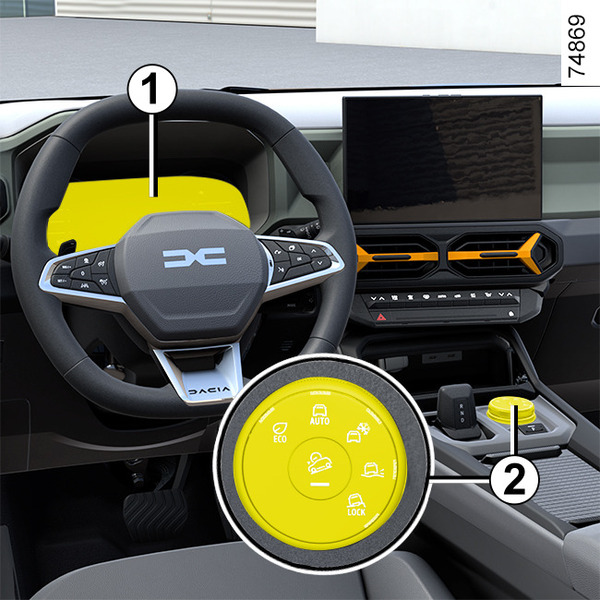
Depending on the type of roads or tracks you are taking and the external conditions, you can select from five driving modes:
- "ECO" mode (default mode every time the vehicle is started when selected);
- "AUTO" mode (default mode every time the vehicle is started, depending on the vehicle);
- "SNOW" mode;
- "MUD-SAND" mode;
- "OFF-ROAD" mode.
All the modes are preset. Each of these modes is characterized by specific settings for:
- steering force;
- electronic stability control (ESC and traction control);
- accelerator pedal sensitivity and engine responsiveness;
- the engine torque distributed between the front and rear axles.
Turn the selector 2 to select the mode that best suits the driving and road conditions.
The selected mode is displayed on the instrument panel 1.
tip
Special cases
Depending on the selected mode and the grip conditions encountered, the ESC intervention may reduce engine power to limit slipping of the drive wheels.
In some off-road situations, it is possible to deactivate the ESC function in order to manage wheelspin and vehicle traction manually.
" ECO " mode
Using "ECO" mode optimises fuel consumption.
It acts on some of the vehicle's energy-consuming systems (air conditioning, etc.) and on vehicle performance (acceleration, cruise control, deceleration, etc.)
Use this mode on paved roads.
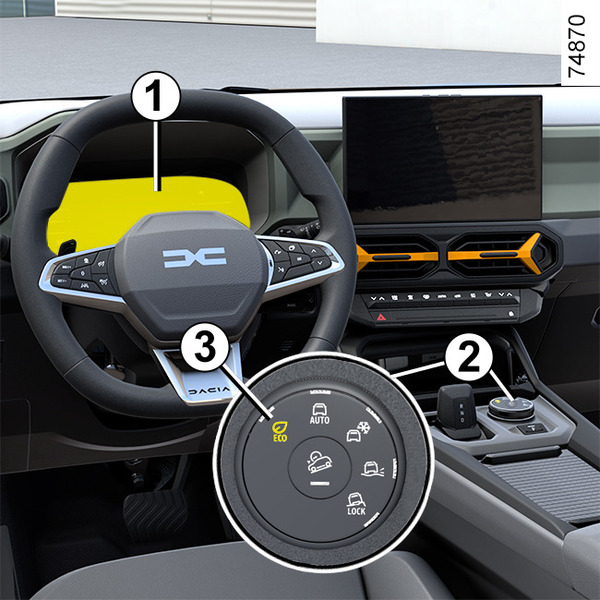
To activate this mode, turn the selector 2 to "ECO" position 3: the light on the selector comes on and the "
 " warning light is displayed on the instrument panel 1 to confirm that it is activated.
"ECO" mode automatically distributes the engine torque between the front and rear axles according to the roadholding conditions and the vehicle speed.
Note: when driving (e.g. when overtaking), it is possible to temporarily regain the engine's optimum acceleration capabilities. To do this, press the accelerator pedal firmly and fully. "ECO" mode is reactivated when you ease off the accelerator pedal.
To change modes, turn the selector 2 to a different position. The "
" indicator light disappears from the instrument panel 1 to confirm deactivation and the newly activated is displayed.
" AUTO " mode
"AUTO" mode is the default mode to be used on the road.
It is a versatile mode that covers the majority of uses intended for the usual road conditions.
The torque is automatically distributed between the axles according to the road condition and speed.
Use this mode on paved roads or when towing (trailer, caravan, etc.).
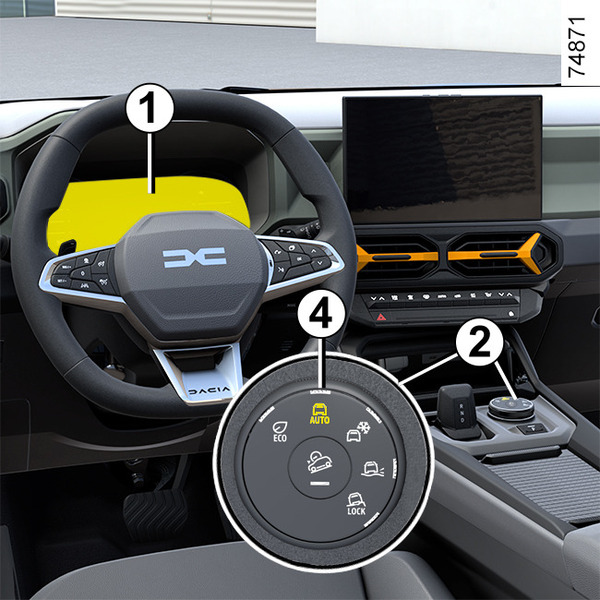
To activate this mode, turn the selector 2 to "AUTO" position 4: the light on the selector comes on and the "AUTO" indicator light is displayed on the instrument panel 1 to confirm that it is activated.
"AUTO" mode automatically distributes the engine torque between the front and rear axles according to the roadholding conditions and the vehicle speed.
This mode optimises road holding.
To change modes, turn the selector 2 to a different position. The "AUTO" display disappears from the instrument panel 1 to confirm deactivation and the newly activated mode is displayed.
" SNOW " mode
"SNOW" mode allows you to optimise your vehicle's electronic stability control on slippery roads (snow, ice, etc.).
The electronic stability control ESC and traction control interventions are enabled and the steering force is increased.
Use this mode on paved and slippery roads.
Note: the use of "SNOW" mode is not suitable in certain driving situations (on soft ground, deep snow, mud, sand, etc.).
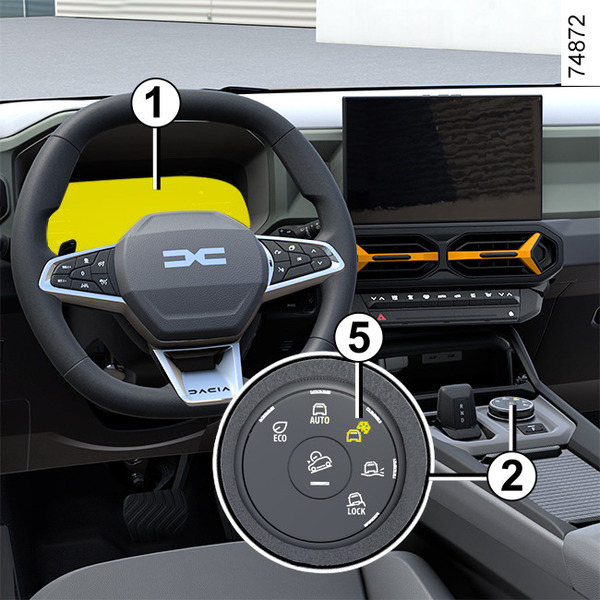
To activate this mode, rotate the selector 2 to the "SNOW" position 5: the indicator light on the selector lights up.
The "SNOW" warning light appears on the instrument panel 1 to confirm activation.
"SNOW" mode automatically distributes the engine torque between the front and rear axles according to the roadholding conditions and the vehicle speed.
To change modes, turn the selector 2 to a different position. The "SNOW" display disappears from the instrument panel 1 to confirm deactivation and the newly activated mode is displayed.
" MUD-SAND " mode
"MUD-SAND" mode allows you to make progress on soft ground in conditions of reduced grip (sand, mud, deep snow, etc.).
The "traction control" function is adapted to keep the engine speed under your control and to help you move your vehicle forwards by digging the ground to find a surface with better grip.
Use this mode only off paved roads and on soft ground.
Note: in this mode, on Hybrid‑G4x4 versions the rear electric motor will cease to operate beyond approximately 43 mph (70 km/h). The system will automatically switch to two-wheel drive mode.
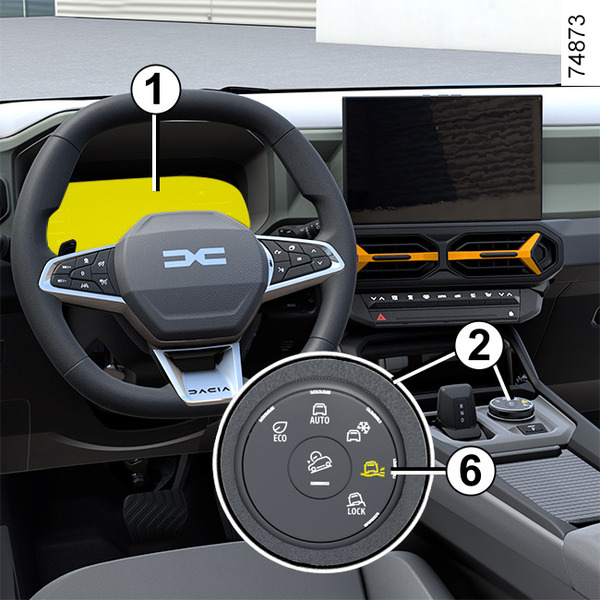
To activate this mode, turn the selector 2 to "MUD-SAND" position 6: the indicator light built into the selector lights up and the "MUD-SAND" warning light appears on the instrument panel 1 to confirm activation.
"MUD-SAND" mode distributes engine torque between the front and rear wheels in all grip conditions, under certain speed conditions.
To change modes, turn the selector 2 to a different position. The "MUD-SAND" display disappears from the instrument panel 1 to confirm deactivation and the newly activated mode is displayed.
" OFF-ROAD " mode ( LOCK )
Using "OFF-ROAD" mode maximises your vehicle's performance in off-road situations (damaged roads, difficult crossings, steep uphill and downhill slopes, etc.).
Use this mode only when off drivable roads and on difficult terrain.
Note: in this mode, on Hybrid‑G4x4 versions the rear electric motor will cease to operate beyond approximately 43 mph (70 km/h). The system will automatically switch to two-wheel drive mode.
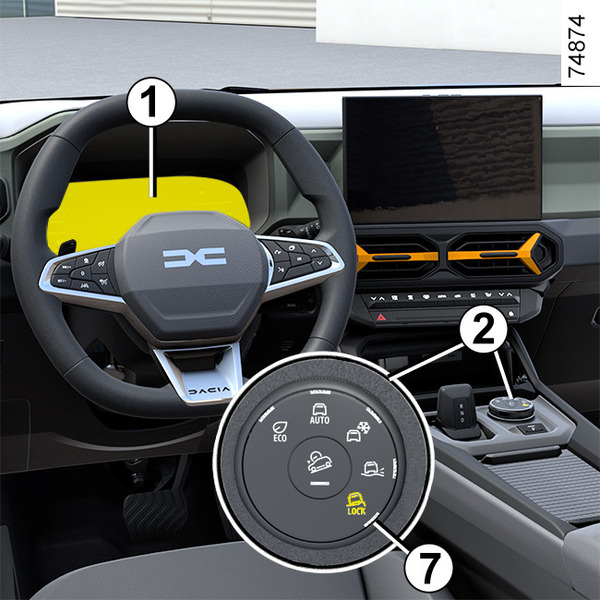
To activate this mode, rotate the selector 2 to "OFF-ROAD" position 7: the indicator light built into the selector lights up and the "OFF-ROAD" display and the orange
 warning light appear on the instrument panel 1 to confirm activation.
"OFF-ROAD" mode distributes engine torque between the front and rear wheels in all grip conditions, under certain speed conditions.
To change modes, turn the selector 2 to a different position. The "OFF-ROAD" display and the
warning light disappear from the instrument panel 1 to confirm deactivation and the newly activated mode is displayed.
tip
The Active Emergency Braking and Adaptive Cruise Control functions Stop and Go are not activated in "SNOW" and "MUD-SAND" mode Active emergency brakingStop and Go adaptive cruise control.
Special features of the 4-wheel drive transmission
If the system detects a difference in size between the front and rear wheels (e.g. under-inflation, significant wear on an axle, etc.), the "4-wheel drive" system automatically switches to "2-wheel drive" mode: the
 warning light is displayed on the instrument panel 1accompanied by the "4 wheel drive unavailable" message and, depending on the vehicle, the "4 wheel drive unavailable unsuitable tyres" message.
Note: the problem may be resolved by replacing the tyres. Always use four identical tyres (same brand, profile, etc.) and with similar wear.
Depending on the vehicle, in the event of excessive stress resulting in abnormal overheating of the system:
- the
warning light is displayed on the instrument panel 1 accompanied by the "4WD Overheating (or 4x4)" message;
- if the wheels still spin, the system automatically switches to "2-wheel drive" operation to protect the mechanical components.
In this case, stop as soon as possible to allow the system to cool down. This cooling can last for several minutes.
Once the 4x4 system is operational again, the
warning light disappears and the
warning light will be displayed again on the instrument panel.
Anti-lock braking in " OFF-ROAD " mode
When "OFF-ROAD" mode is activated, the ABS automatically switches to an off-road setting. In this case, the wheels may lock intermittently to achieve better grip and use the surface material to reduce braking distances on soft ground.
When "OFF-ROAD" mode is activated:
- the vehicle's manoeuvrability is limited during braking. This operating mode is therefore not recommended in very low-grip conditions (e.g., ice);
- depending on the vehicle, you may hear noise. This is normal, and does not indicate an operating fault.
Electronic stability control ( ESC ) and traction control when driving off-road
This function acts on the engine torque and brakes the wheel(s) that are slipping. It allows engine torque to be transmitted to the wheel(s) with the most traction. This is particularly useful when crossing a bridge.
The traction control is adapted to the mode selected.
All the ESC functions will be automatically reactivated when the vehicle speed exceeds approximately 31 mph or 50 km/h, or after restarting the engine or pressing the "ESC" button again Driver correction devices and aids.
Note: the traction control system is reactivated only after the engine is restarted or by pressing the "ESC" button.
Operating faults
When the system detects a malfunction, the system automatically switches to "2-wheel drive" mode and the
,
 warning lights and the "Check 4 wheel drive" message appear on the instrument panel.
Drive as soon as possible at a moderate speed to an Approved Dealer.
Warnings
warning
4-wheel drive system
- Regardless of the mode selected, do not start the engine if all four wheels are not on the ground.
- Do not turn the mode selector when cornering, reversing or if the wheels are spinning excessively.
- The "MUD-SAND" and "OFF-ROAD" modes are exclusively reserved for driving off-road. Using these modes in any other conditions may adversely affect the vehicle's manoeuvrability and damage certain mechanical components.
- Always ensure tyres with identical specifications are fitted to all four wheels (brand, size, structure, wear etc.). Fitting tyres of different sizes to the front and rear wheels and/or left-hand and right-hand wheels may have serious consequences for the tyres and mechanical drive components (gearbox, transfer box, coupler 4x4, rear differential, etc.).