Dacia Bigster
Introduction
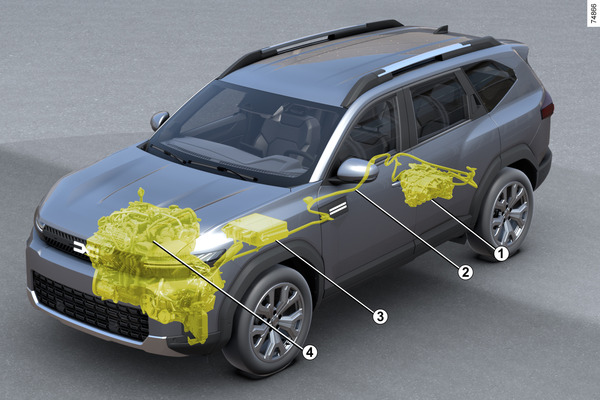
- 1
- Electric motor
- 2
Orange electrical power cables
- 3
- "48 V" secondary propulsion battery
- 4
Combustion engine with LPG bi-fuel
The system combines hybrid technology and LPG bi-fuel:
- the Hybrid system improves engine performance. The vehicle has more acceleration torque available while consuming less fuel ;
- the LPG system allows the vehicle to operate by bi-fuelling using two types of fuel: LPG and petrol. For more information LPG vehicle;
- the vehicle is equipped with two separate tanks LPG tank.
Secondary "48 V" battery
Located under the front passenger seat, this battery stores the energy recovered during phases of deceleration.
This energy is used by the hybrid system to exclusively power the electric motor at the rear of the vehicle. For more information Secondary "48 V" battery.
If your vehicle is parked for a long time, start the engine at regular intervals (about once a month) for about 15 minutes to recharge the secondary "48 V" battery.
Failure to do so may result in damage to the battery and make it impossible to start the vehicle.
"48 V" electrical circuit
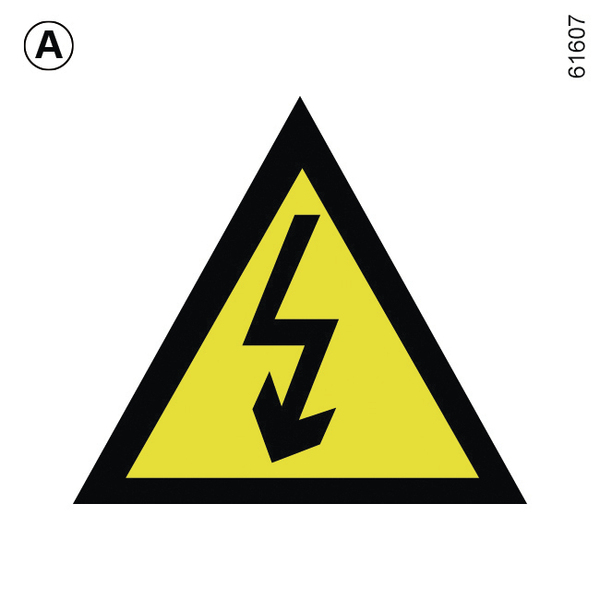
The "48 volt" electrical circuit is denoted by yellow cables and parts bearing the
 symbol.
The A symbol identifies the electrical elements in your vehicle which may present safety risks.
tip
The "48 V" secondary propulsion battery does not require maintenance. You should not open it or add any fluid.
Risk of electric shock.
Air vent 5
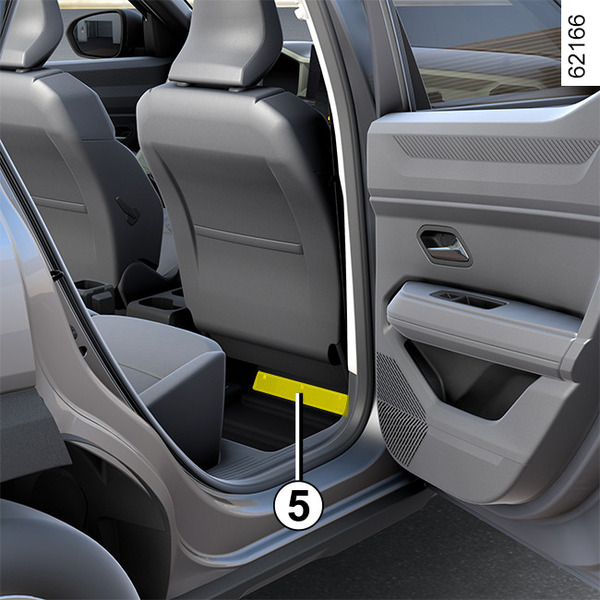
Ensure that no objects or fluids enter the air vent 5.
If an object enters the air vent or there is a fluid leakage, please contact an Approved Dealer.
Note: you may hear ventilation noises from underneath the front right-hand seat while the "48 V" secondary propulsion battery is being cooled.
If the "48V battery cooling: obstructed under seat grid" message appears on the instrument panel, clear the vent of any obstructions.
If the message persists after the vent is cleared, consult an Approved Dealer.
tip
Take care not to obstruct the air vent 5.
If the vent is obstructed (e.g. due to an object placed over it), the "48 V" secondary propulsion battery may overheat and hinder the performance of the electric motor.
Noise
The Hybrid vehicles are particularly quiet in electric operating mode. You will not yet necessarily be used to it, and neither will other road users. It is difficult for them to hear your vehicle when it is moving.
As the electric motor is silent, you will hear noises that may seem unusual (aerodynamic noises, tyres, etc.) as well as noises due to the operation of the Hybrid system (e.g. cooling of the "48 V" secondary propulsion battery).
Pedestrian horn
The pedestrian horn enables you to warn others of your presence – especially pedestrians and cyclists.
When the engine is started, the pedestrian horn is activated automatically. The sound is triggered when the vehicle speed is between about 1 and 19 mph (1 and 30 km/h).
In the event of a fault with the pedestrian horn, the "Failure Outside sound" message is displayed on the instrument panel. Consult an approved Dealer.
Operation
The Hybrid-G 4x4 system selects the combustion engine and/or the electric motor according to the driving style (smooth, sporty, etc.), the traffic conditions and driving mode selected according to the road type Transmission: 4-wheel drive.
Bad weather, flooded roads:
-

Do not drive through floods if the depth of water is above the lower edge of the wheel rims.
Energy flow indicator 6
Vehicle equipped with an on-board computer A
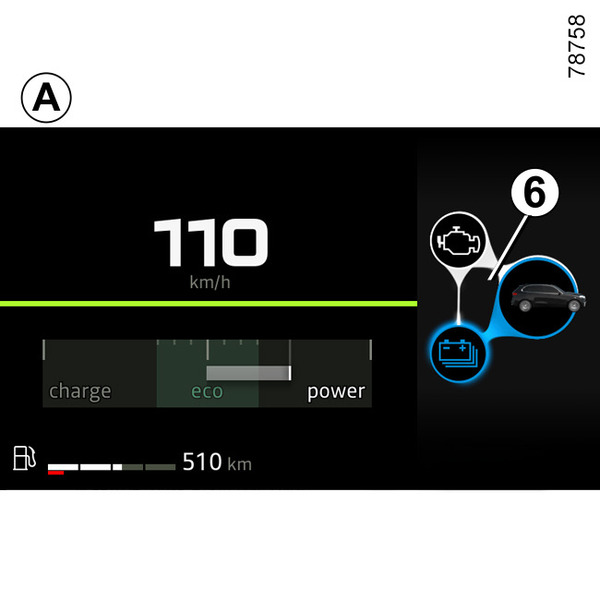
Depending on the driving mode selected, the warning light 6 represents the energy flows between:
-
 the electrical assembly ("48 V" secondary propulsion battery and electric motor);
 -
 the combustion engine;
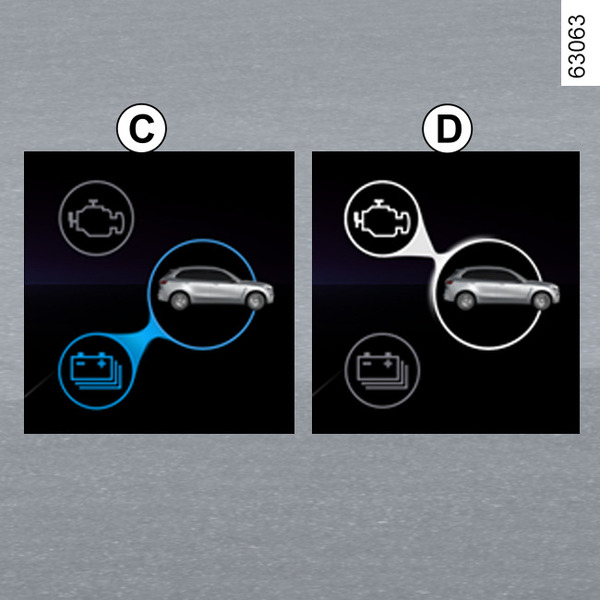
The colour of flows varies:
- blue: electrical energy;
- white: energy produced by the combustion engine.
Flow C"Electrical propulsion"
The electrical assembly is used to move the vehicle.
Flow D "Combustion engine traction"
The combustion engine is used to move the vehicle.
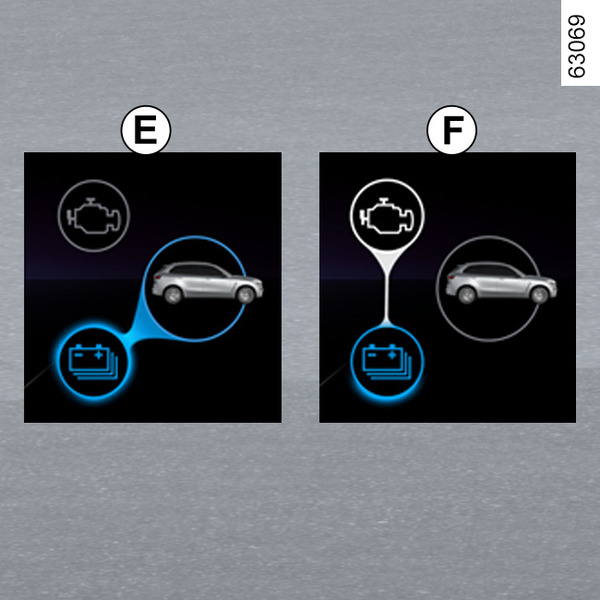
Flow E "Energy recovery"
When you lift your foot off the accelerator pedal or when you press on the brake pedal, the electric motor and/or the regenerative braking system convert the energy produced by the vehicle deceleration into electric energy.
This is used to brake the vehicle and recharge the "48 V" secondary propulsion battery.
Flow F "Energy production"
The combustion engine will recharge the "48 V" secondary propulsion battery.
Note: a combination of different flows is possible (e.g. combining flow C and flow D means that the combustion engine and the electric motor are being used to move the vehicle).
Vehicle equipped with on-board computer B
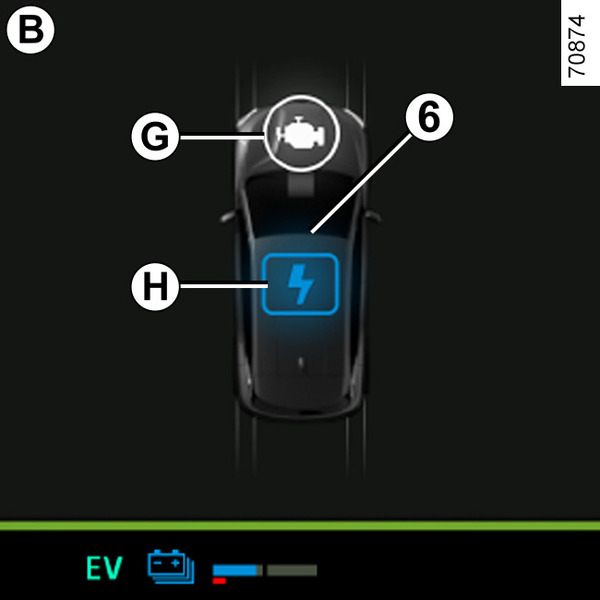
Depending on the driving mode selected, the various energy flows are shown on the instrument panel.
These are energy flows between:
- G: the combustion engine;
- H: the electrical assembly ("48 V" secondary propulsion battery and electric motor).
The colour of flows varies:
- blue: electrical energy;
- white: energy produced by the combustion engine.
warning
The engine brake should under no circumstances be used as a substitute for the brake pedal.
All-electric driving mode
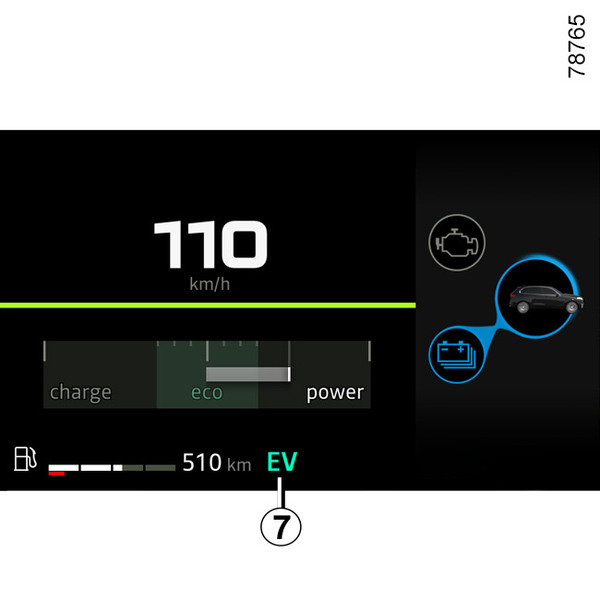
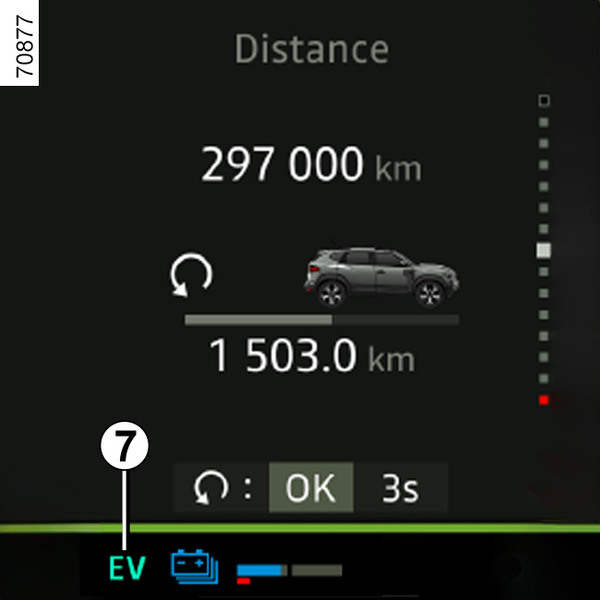
The warning light 7
 is displayed on the instrument panel to inform you that the Hybrid system is using only the electrical assembly to power the vehicle movement.
Note: depending on the vehicle, when the vehicle is operating in all-electric mode the steering wheel paddles are not activatedGear change paddles <cite>4</cite> and <cite>5</cite>.
tip
It is not recommended to drive the vehicle while the petrol tank and/or LPG tank is empty.
If the orange
 and/or yellow
 warning light appears on the instrument panel accompanied by a beep, fill the corresponding tank as soon as possible.